"The pawn outpost on d5 in the Dragon"
by Mihail Marin
This sample features an abridged version of Mihail Marin’s article, including just one training question for each of chapters A) through D), as well as the introductory video. The original article in ChessBase Magazine #231 includes a total of 12 training examples plus two interactive training videos!
Video introduction
This is the structure we will examine in this article:
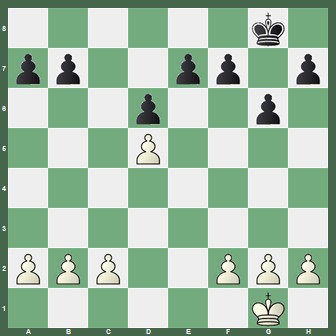
It typically arises from the Dragon Sicilian, when White plays Nd5 and Black exchanges it. With reversed colours, it is typical for the English reversed Dragon.
I will distinguish this structure from a similar one that is typical of the Maroczy bind. In that case, White has their queen's bishop pawn on c4, strengthening the centre and reducing Black's possibilities for counterplay.
The strategic and the tactical fight resulting from this structure centres around a few important questions:
1) Is the d5-pawn strong or weak?
2) Can White use the relative weakness of the backward e7-pawn?
3) Which are the consequences of ...e7-e6/e5?
4) Can White launch a kingside attack? Or is the resolute advance of the pawns just a weakening of White's own kingside?
5) How dangerous is Black's minority attack based on the advance of the a- and b-pawns, pressure along the c-file and the activity of a knight on c4? Can White use the c6-square for their knight, or take advantage in any other way of the weaknesses left behind by the pawns?
6) Which of the players benefits from the queens' exchange?
I have created the following chapters:
- A) The backward pawn
- B) The kingside attack
- C) The queenside counterplay
- D) The weakness of the d5(d4)-pawn
As we move forward through the chapters, you may notice that in each of them, previously examined themes are still present, as an amplification of the strategic battle. For instance, the queenside counterplay can be effective only if everything is in order with the backward pawn and the whole kingside. Moreover, the relative weakness of the d5-pawn can be an advantage if the queenside counterplay is successful.
A) The backward pawn
The relative weakness of this pawn may turn into Black's main problem, if not dealt with in time.
Optical evidence can be deceptive. In Hoffmann,H - Reinhardt,E 1-0, it may seem that White could not dream of more.
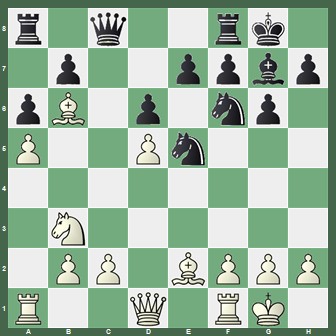
However, Black's defensive resources are not to be underestimated. Reinhardt hit onto the correct idea, but his timing was not optimal.
B) The kingside attack
This structure is a particular case of Sicilian structures, which implies that a kingside attack remains an important possibility.
Kostic,B - Noteboom,D 1-0 bears some connection with the previous section.
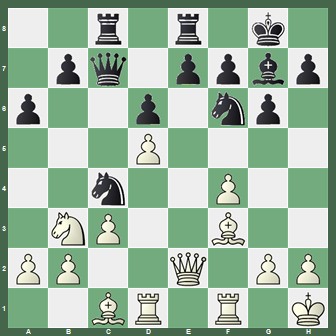
Both sides are harmoniously developed, but out of the two natural plans, Black failed to choose the one with the highest priority and went down painfully.
C) The queenside counterplay
As in virtually any Sicilian system, the main plan for a player adopting the Dragon structure is a queenside attack. Since the d5-pawn strongly restricts Black. using small concrete details is essential to make the counterplay effective.
Black handled this issue well in Suechting,H - Chajes,O 1-0.
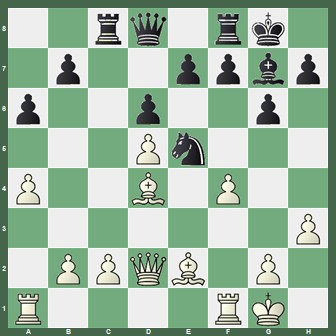
Given a choice between a static and a dynamic approach, he picked up the right one. Later, he failed to maintain the balance between the elements examined in the previous sections and got into trouble.
D) The weakness of the d5(d4)-pawn
As mentioned before, the advanced outpost can become weak as a result of an effective queenside attack. But many times, the opponent's inaccurate manoeuvring can help.
Nepomniachtchi,I - Georgiev,K 1-0 is only apparently a trivial example.
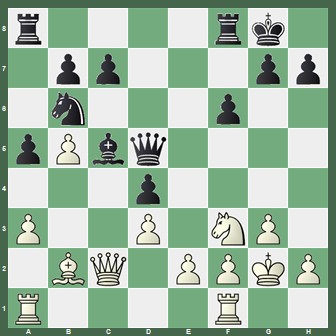
Black lost his pawn to a simple operation only a few moves later, but he could have avoided that if he adopted the correct setup at this stage.