ChessBase Magazine
London System 3.e3 e6 4.Nf3 Bd6 5.Bd3
Inviting the bishop trade
London System - Christian Braun counters the modern 4...Bd6 with 5.Bd3!?
Our starting position arises after 1.d4 d5 2.Bf4 Nf6 3.e3 e6 4.Nf3 Bd6 (the modern continuation, Black immediately challenges the London bishop f4) 5.Bd3!?.
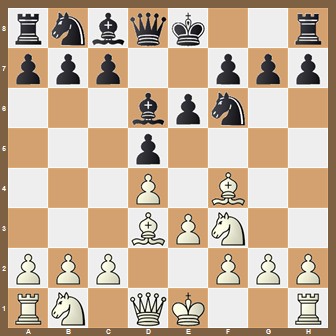
5.Bd3!? occurred in 845 games, scoring 56.9% and thus higher than 5.Bg3 (7.485 games/54%) and 5.Ne5 (3.171 games/58.7%). The advantage compared to those main moves is that we remain really flexible and can react on Black's different setups very well. For example, the queen's knight is usually developed to d2, but in some cases it also goes to c3 or even a3. In most lines White gets an easy and good development, while Black has problems getting their pieces out, especially the bad bishop c8. I have been very much inspired by the game Van Foreest,J - Keymer,V 1-0 (Tata Steel 2026) where Jorden managed to crush Vincent with 5.Bd3!? in barely 26 moves!
My game analyses are intended to help you better understand the resulting positions and to provide you with interesting ideas against one of the most frequently played variations of Black in the London System!
I will discuss the following continuations: A) 5...c5 6.dxc5 Bxf4 7.exf4, B) 5...Bxf4 6.exf4 Qd6 7.Qd2 b6 (and other 7th moves), C) 5...0-0 6.0-0 Bxf4 7.exf4 Qd6 (and other 7th moves), D) 5...0-0 6.0-0 c5 7.dxc5 Bxc5 8.Nbd2 Nc6 (and other rare 8th moves), E) 5...0-0 6.0-0 Bxf4 7.exf4 - sidelines, F) 5.Bd3 - sidelines and G) 5...0-0 6.0-0 b6 7.Qe2.
A) 5...c5 6.dxc5 Bxf4 7.exf4
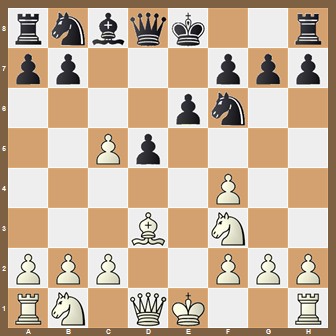
Black has induced White's pawns to capture away from the centre, and in the game Rapport,R - Sadhwani,R 1-0 now regained the pawn with 7...Qc7. After 8.g3 Qxc5, White can follow up with Nbd2-b3,
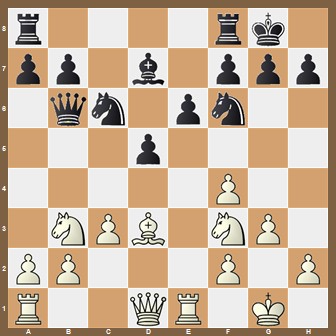
gaining firm control over the dark central squares d4 and e5, with potential to attack the enemy king. Meanwhile, Black remains very passive, and the bishop on c8 is an especially poor piece.
B) 5...Bxf4 6.exf4 Qd6 7.Qd2 b6 (and other 7th moves)
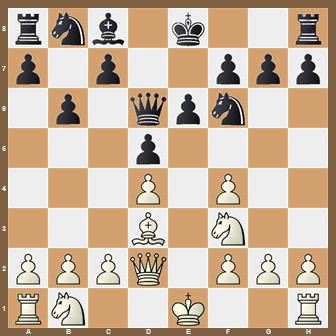
Black prepares c7-c5. The mentioned encounter Van Foreest,J - Keymer,V 1-0 saw 8.Nc3 (an unusual move in this line) c5 9.h4,
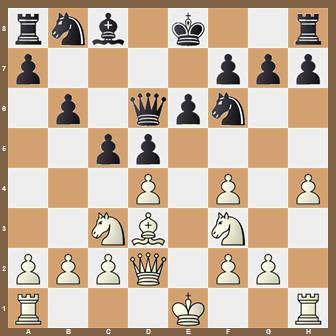
intending h5-h6 to weaken the dark squares on Black's kingside. Note that White holds off castling and can still play both 0-0-0 and 0-0! Jorden beat Vincent right out of the opening. This was the game which inspired me to write this article. The annotations also deal with black alternatives on move 7.
C) 5...0-0 6.0-0 Bxf4 7.exf4 Qd6 (and other 7th moves)
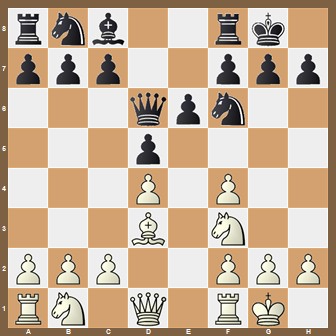
Black attacks the pawn f4. The game Boehme,S - Heinemann,J 1-0 continued 8.g3 b6 (intending ...Ba6 to exchange the bad bishop) 9.Qe2 a5 (9...c5 10.c3) and here 10.Na3 would have been interesting -
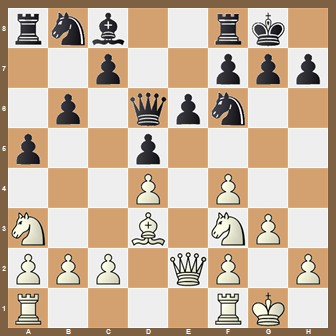
White is ready to play c4 and has good knight control over the squares b5 and e5! The game notes also deal with black alternatives on move 7.
D) 5...0-0 6.0-0 c5 7.dxc5 Bxc5 8.Nbd2 Nc6 (and other 8th moves)
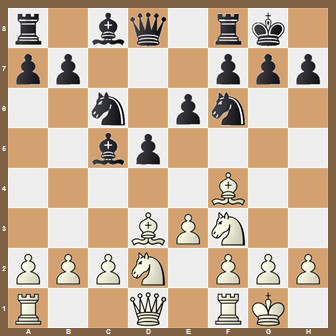
Recapturing on c5 with the bishop (i.e. no exchange on f4) costs a tempo and thus gives White a small lead in development. Also, again Black's Bc8 is quite passive here and does not come into the game so fast. White has two levers to put the centre under pressure, e4 and c4. In Salna,A - Svane,R ½-½, 9.c4! gave White the option to play on the c-file or to expand on the queenside with a3 and b4. The game notes also deal with black alternatives like 8...Nbd7 or 8...b6 (9.e4!).
E) 5...0-0 6.0-0 Bxf4 7.exf4 - sidelines
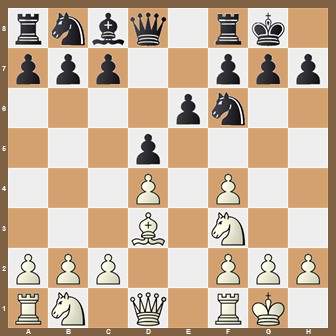
The Indjic,A - Cremisi,D 1-0 continued 7...Nbd7 8.Nbd2 c5 9.dxc5 Nxc5, and now 10.Nb3!? Nxd3 11.cxd3!
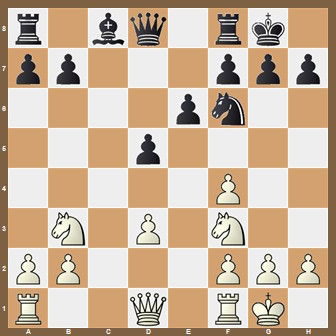
would have given White nice control over d4 and e5, while Black (again!) is left with a bad white-squared bishop! Another nice manoeuvre in these lines with ...Bxf4/exf4 that I would like to point out here is White's rook lift via e1-e3 to the kingside. The game commentaries also discuss alternatives for Black on move 7.
F) 5.Bd3!? - sidelines
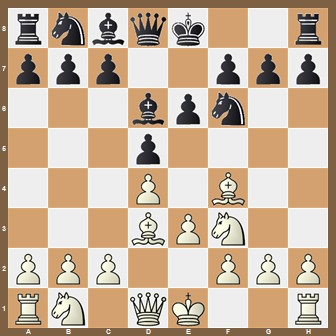
In the analysis of the game Rosen,E - Aarav,S 1-0 , we will look at positions in which Black does not seek counterplay with the important lever ...c5. Then, White's standard plan is to play Ne5 followed by h4,
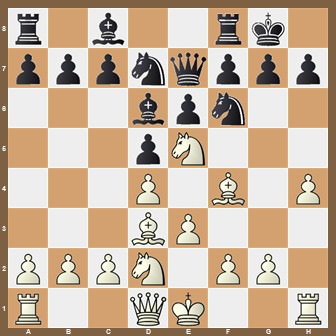
going for a strong attack against Black's king.
G) 5...0-0 6.0-0 b6 7.Qe2
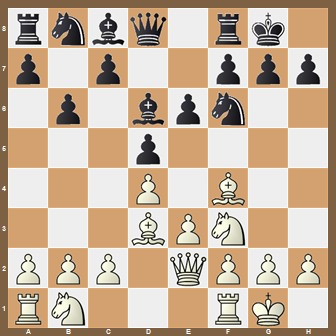
6...b6 (without exchanging the bishop on f4) is a flexible move. Apart from preparing ...c5, Black can either continue ...Bb7 to control the e4-square and to put their Nf6 there, or exchange their bad white-squared bishop against White's good one via a6. 7.Qe2 prevents this. The high-class game Bluebaum,M - Vidit,S ½-½ continued 7...Ne4 8.Bxd6 Nxd6 9.Nbd2 Bb7, and now the advance 10.e4!?
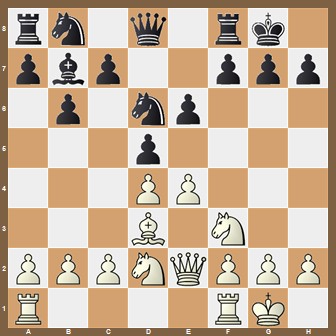
gave White space advantage and a slight pull - 10...dxe4 11.Nxe4 Nd7 12.c4.
Conclusion: I like the flexible 5.Bd3!? very much. White still can decide where to put the Nb1, and Black does not get the control over the e4-square (as after 5.Ne5 for example). Very often, White gets the better development and simply has 'the stronger pieces' than Black. Another plus of 5.Bd3!? is that the arising positions are not mainstream and still a little bit unexplored.
The type of position from the game Rapport,R - Sadhwani,R 1-0, with control over the squares e5 and d4 and with the potential to attack Black's king, will appear on the board quite often - this is actually my favourite variation for White! Also this line with 8.Nc3, featured in the game Van Foreest,J - Keymer,V 1-0, shows how dangerous White's setup is when even a super solid player like Vincent Keymer gets crushed in just 26 moves! In my opinion the best Black can do is either 5...0-0 6.0-0 c5 7.dxc5 Bxc5 (see Salna,A - Svane,R ½-½) or Vidit's setup in Bluebaum,M - Vidit,S ½-½.
So, I wish you good luck for your own games with 5.Bd3!? - smash Black with the London System!