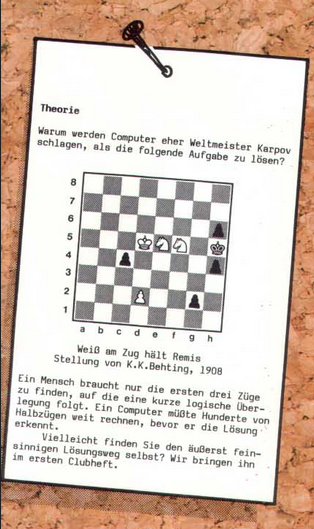
 Close to forty years ago I made a daring prediction. At the time I had founded and edited a German computer magazine, devoted to Artificial Intelligence, chess and games. On the inside cover of the first issue I had a teaser: a chess study, and the prediction that computers would beat the reigning world champion (what an outlandish thought!) before they would be able to solve it.
Human’s, I said in explanation, only need to find the first three moves and then use a quick logical consideration to recognise how White can draw in an apparently hopeless position (full explanation to follow). Computer programs would need to look a hundred moves ahead to understand why they have to play those three moves, and why after that Black cannot possibly win.
And you know something: I was right. Computers started beating World Champions and outstripping the world’s strongest players by hundreds of rating points, but – until recently – could not solve this study. Only since a few years they have been able to do so, after very deep searches or with the help of neural networks.
So let us take a closer look at the position. It looks like quite a straightforward, simple study: just two knights and a few pawns. But it goes beyond the horizon of most computers – and also of most human beings.
The best way to solve the study is to use computer assistance. At the end of this chapter you will find a replayer with engine support for your analysis. You can try playing the white side against the program, and let it attack with the black pieces. Unless you find the one precise and correct solution, it will frustrate your every attempt to hold the position for White.
On the other hand, you can let a powerful chess program work on the diagram position, for many hours – or days if necessary. It is probably too much to expect it to find the correct first move with a 0.00 evaluation (indicating a draw). But it is interesting to see if it can find just the correct move, even though it may think that the position is still hopelessly lost for White.
So what is this mysterious, this legendary first move? Well, it is, as endgame legend John Roycroft wrote, simply one of the deepest move in his book The Chess Endgame Study. And here it is: 1.Kc6!! Truly staggering, that only this completely irrelevant looking move secures the draw. The reason will become clear shortly.
1...g1Q. This is the only reasonable attempt for Black to win. In the analysis below we show why 1...h3 or 1...Kg5 only draw. 2.Nxh4! Now 2...Kxh4?? is impossible, because of 3.Nf3+, with a win for White. Black has only this one check, which is the reason that 1.Kc6!! was required in the starting position. If the king was on d5 or had moved to any other square, the queen would have a relief check. But now White can defend with the drawing move 3.Nhf3.
Take a look at the position. After 3.Nhf3 the black king will be completely immobilized by the two knights, which protect each other. White will leave all his pieces in place and move around with his king. Black can only give checks with the queen, and the white king simply moves away. The position is an iron-clad draw, as you will readily see. Try it out: play the move 3.Nhf3. The diagram will try to win with the black pieces, but if you avoid the white king getting immobilized in a corner, it will not succeed.
Over the years, while their computers still struggled, fans and experts tried to see if there was a different way for White to hold the draw. Is the study completely sound, or does White have a possible alternative to the intended key? After 1.Ng7+ Kg5 2.Nf3+ Kg4 3.Ke4 h3 4.Nf5 g1Q 5.Nxg1 h2 6.Nxh6+ Kh5 (6...Kg3 7.Nf5+ Kg2 8.Nf3 h1Q 9.N5d4 is very similar) 7.Nf3 h1Q 8.Nf5 Kg4 9.Ne3+ Kg3 10.Nf5+ Kf2 11.N5d4 we reach an interesting position with Q+P vs 2N+P. Since in general positions with Q v 2N are drawn, if Black is to win he has to make progress without allowing an exchange of pawns. It isn't obvious how he can do this, although there are various attempts which come close to succeeding. Grandmaster John Nunn and other experts analysed the alternate line meticulously, and endgame tablebase expert Marc Bourzutschky in fact constructed the seven-man tablebase Q+P vs 2N+P to assist in the analysis.
In the end Dr Nunn came to the conclusion that “Behting’s 1908 study has, after just over a century, been proved correct, and we can continue to use it to humiliate computers.
So how about the latest chess engines? Are they able to find the key move and understand why it must be played? Let us take a look:
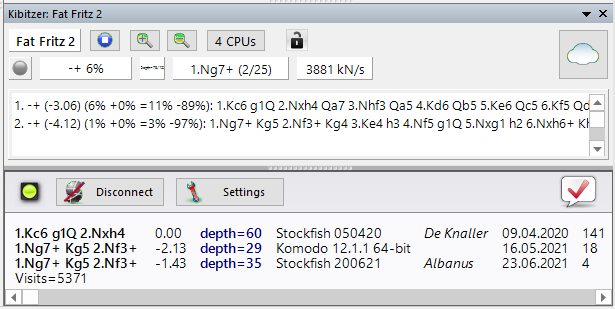
The AI neural network program Fat Fritz (top) finds the correct strategy, but still thinks Black will probably be able to win in the end. In the bottom half, which displays the results obtained on the most powerful (private) computers in the world, running for a long time, you can see that a recent version of the program Stockfish, displays the key white moves, with a 0.00 drawing score. It would appear that the program has worked out, at a depth of 60 ply, that Black cannot win.
You can view the main lines of John Nunn's analysis, and indeed play around with the intended solution in our replayer here: