In my rookie days as a journalist I worked for a German TV science anchor named Hoimar von Ditfurt, who was famous, quick-witted and intelligent. With him and a journalist colleague named Wolfgang Runkel, I played a game we called the "handshake chain." The point was to find how many handshakes away you are from any given person. For example, I was two handshakes away from the President of Germany, because I had shaken hands with someone who had shaken hands with someone who had shaken hands with him. Wolfgang was one handshake away, Hoimar was zero, since he regularly fraternized with the President. In our method of counting, directly shaking hands with someone meant your handshake distance was zero.
My contest with Wolfgang was fairly close, although he was usually the winner. Against Hoimar I did not have the ghost of a chance. He was part of German aristocracy, a well-respected professor, son of a famous historian. He had met and broken bread with everyone of name and fame. Typically, I was four handshakes away from some famous personality (e.g. Albert Einstein), while Hoimar would be just one.
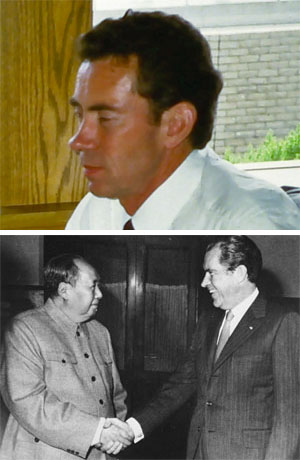
Mao shaking hands with Nixon
That changed in 1979, when I was assigned to do a research project in the budding field of "Artificial Intelligence" (yes, at the time we still put it in quotes). For this, I took a trip around the world – Hamburg, New York, California, Japan – visiting all the important AI labs. On this trip, I got to meet a number of famous people, or persons close to them.
When I got back, I could challenge Hoimar: "Mao Zedong" I said to him. My score was two, since I had met Richard Nixon's brother on the trip, and Nixon had shaken hands with Mao. Naturally Hoimar, after an hour of mulling over it, came up with a one-handshake score. I could only beat him, occasionally, on US politicians (like Dwight D. Eisenhower) due to the key encounter with Edward Nixon. But usually, sometimes the next day, Hoimar would think of something that shortened his chain, and he drew parallel or beat me.
The Chess Handshake Chain
So now we come to the reason I am telling you all this: I have proposed a Chess Handshake Competition. How many handshakes are you away from famous players? We will assume that when two players have faced each other in a game they will have shaken hands (in pandemic times we will assume that a fistbump or being in close proximity across the board counts as well). Say you played in a simul against Korchnoi (and conceded defeat with a handshake). Then your handshake score for Spassky, Karpov, Kasparov, and many others is one.
What is the best way to work out chains? Think of some good player you have met, and then search for his games in a big chess database. Personally, I have met a lot of strong players: Kasparov, Karpov, Korchnoi, Spassky, Euwe, Botvinnik and, most importantly, Samuel Reshevsky. So it is tough for anyone to beat me. Here are some examples:
-
Emanuel Lasker: my handshake score is one (Reshevsky played Lasker in 1920)
-
Rubinstein, Janovsky, Drake, Fine, Capablanca, Aljechin, and many others: one! Me-Rechevsky-them – as you see, meeting Samuel was incredibly important!
-
Alan Turing: one! I met Donald Michie, who worked with Turing at Bletchley Park.
How about Steinitz? Morphy? I have got the latter down to four and am still hoping for a three (or even two). The Duke of Brunswick? Ruy Lopez? François-André Danican Philidor? I am still working on them?
Hang on: it occurs to me that on a trip to Budapest I was introduced to GM Andor Lilienthal, over ninety years old at the time. Lilienthal had played against ten world champions, beating a number of them in the process: Lasker, Capablanca and Alekhine”, the second, third and fourth world champions. So I have two paths to these players.
A small humorous interlude: I was recently discussing the chess handshake chain with a young grandmaster. He was very impressed by my score of one to Capablanca. "I wonder what my score to Capa could be," he said. "Seven? Ten?" – "Probably," I replied, "Such a pity you have never met me!" – "Of course!" he exclaimed, "Tell me, how can anyone be so dumb as me?"
ChessBase Winchain utility
Some time ago my friend Christian Hesse described the concept of "winchain" – is there a player you have beaten, who has beaten someone, who has beaten someone, who beat a World Champion? It is astonishing how close you can get – like a 2144 player being just three steps away from Magnus Carlsen.
Fabian Brinkmann, one of our young programmers, has written a nice little ChessBase app which will help you search for winchains. This is how you can use it to find your winchain number:
Most of our readers will know the ChessBase Players Gallery. It allows you to search for any player and get statistics and games.
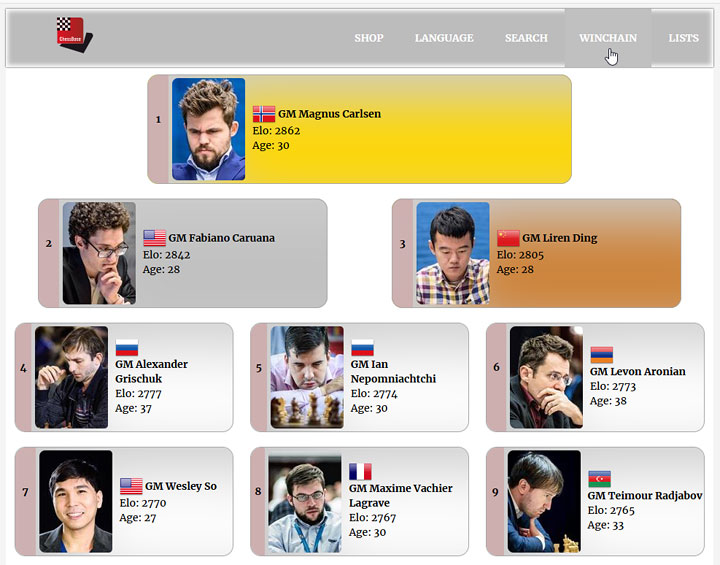
Clicking on Wesley So, for instance, will give you an overview of his career:
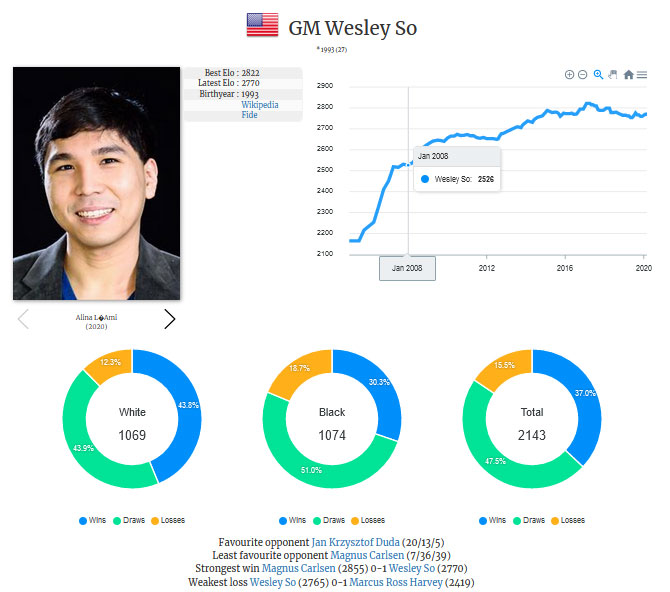
There is an interesting function for Winchain seekers on the ChessBase Players page. You can look for the games in which a player has beaten a World Champion, then for games in which some opponent has beaten them, then the games of that players, and try to build a chain to someone you have beaten. Or you can work the other way around: look at a game of someone you have beaten, and the games in which he has beaten someone else, until you find a world champion. Naturally this presupposes that the games are recorded in Mega Database. But even if you are not in Mega, look for players you have faced that are, and start the chain from there.
 If you are in Mega there is a simpler way. Click on the Winchain button and enter your and the name of a World Champion. The winchain app will search through milllions of games plus and find a winchain if there is one. Naturally, this can take a number of milliseconds.
Here's an example: I typed in the name of the author of the app, rated 2144, and the name of the current World Champion. Here's the result:
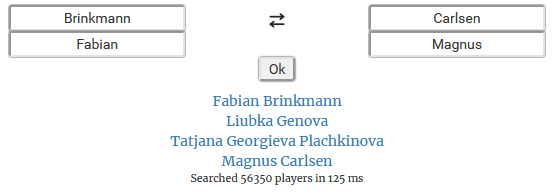
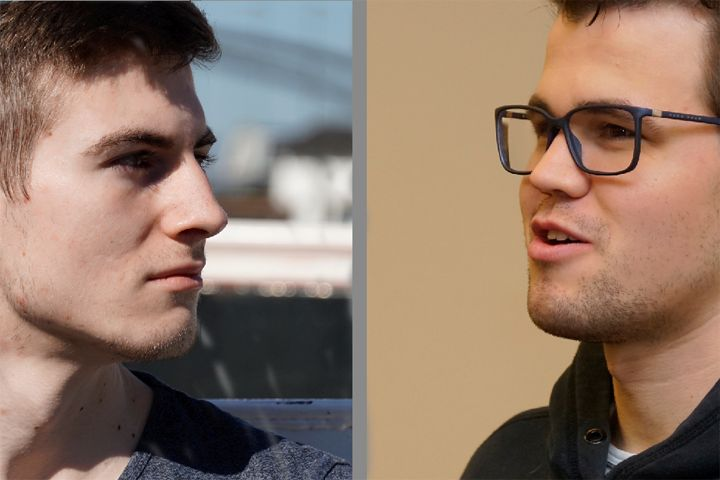
Turns out Fabian has a winchain to Carlsen of just three: he beat WIM Liubka Genova in the Hamburg Easter Open in 2018, and she in turn beat WIM Tatjana Plachkinova in the Bulgarian Women's Championship in 2001. In the Nordic Championship in Bergen, on August 10, 2001, Tatjana beat the ten-year-old Magnus. He had a 2084 rating at the time, while Tatjana was rated 2190. She won after Magnus erred on move 37 (taking the c-pawn with his queen and not his bishop – remember that, Maggi? Bet he does!). All this research took me less than a minute to conduct. After I had entered Fabian - Carlsen, the program found the chain in reasonable time: 125 ms after processing 56,350 candidate players. It also showed me the games on our Javascript replay board.
Fabian is in his twenties, and started as an intern at ChessBase in 2016. Since 2019 he is a permanent part of our development team. He is responsible for many other ChessBase utilities, like the Playchess tournament overview – great tournament tables that are automatically generated. And Fabian designed and programmed the ChessBase E-Book CMS I am using to write this text.