Almost all countries participate in the pagan ritual. Most have a day very much like the Western April Fool's Day. On this day, April 1st, dignity is discarded and everyone plays practical jokes. Also known as All Fools' Day, the occasion provides pranksters of every description an opportunity to play a wide variety of jokes upon their friends and neighbours.
ANCIENT ROME: The custom of playing practical jokes on friends was part of the celebrations in ancient Rome on March 25 (Hilaria). The timing seems related to the vernal equinox and the coming of spring, a time when nature fools us with sudden changes between showers and sunshine.
ENGLAND: In England, April 1st tricks can be played only in the morning. If a trick is played on you, you are a "noodle". Widespread observance in England began in the 18th century.
SCOTLAND: April Fools Day is 48 hours long, and you are called an "April Gowk", which is another name for a cuckoo bird. The second day is called Taily Day and is dedicated to pranks involving the buttocks.
FRANCE: April Fool is called "April Fish" (Poisson d'Avril). The French fool their friends by taping a paper fish to their friends' backs and when someone discovers this trick, they yell "Poisson d'Avril!"
SPAIN: A "Dia de los Santos Inocentes" is held in Spain on December 28th. This is The Feast of the Holy Innocents. It is celebrated similarly to April Fool's Day, with practical jokes.
AMERICA: The English, Scotch and French introduced the custom to their colonies in America. One of our forefathers' favourite jokes was to send someone on a "fool's errand." For example, one might have been asked to go out and obtain a copy of "The History of Adam's Grandfather," or bring back some "sweet vinegar."
MEXICO: The "foolish" tradition is celebrated in Mexico, too, but on a different day and for different reasons. "El Dia de los Inocentes," which is December 28, was set aside as a day for Christians to mourn Herod's slaughter of innocent children. Over time, the tone of that "unluckiest of days" has evolved from sadness to good-natured trickery.
Chess pranks
ChessBase picked up the tradition very early. It came as a spurious report on our news page. Let us look at a few of our April 1st reports. We start with a prank we played twenty years ago.
- The Fischer retractor (1/4/2002) – The reclusive ex-world champion Bobby Fischer had, we reported, introduced a number of important innovations into the game. After the Fischer Clock and Fischer Random Chess, he was now proposing a further change, the "Fischer move", which he now presented to FIDE. It was designed to counteract what he believed was an unbearable preponderance of tactics in chess. To this end, he submitted a rule modification, according to which a player could execute a move as stipulated by the FIDE rules; or instead execute the opponent's and his own previous moves in reverse order, replacing any captured pieces onto their original squares, and then execute an alternative move. Some of the reactions to the prank are reported here. Bobby himself read the story and the readers' feedback. After initial outrage, he could not suppress a loud guffaw, and said he thought the April Fool's joke was "pretty funny."
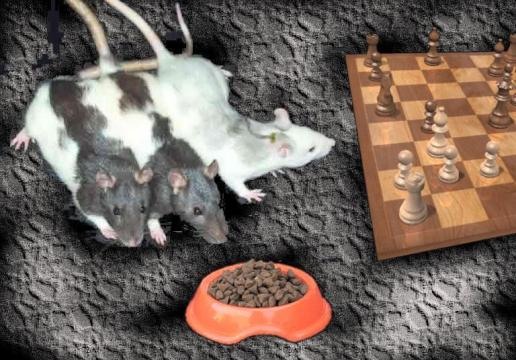 The bionic chess interface (1/4/2003) The next year we described, in erudite academic style, how scientists had hooked a chess playing computer to the hippocampus of a rat. The animal was not able to play chess, or even execute a single legal move. However, rats that were connected with the external chess chip showed a clear interest in a chess board placed within their range of vision.
Over the years it became progressively more difficult to disguise our April Fool's stories. Armed insurgents with advanced Google searches in chess forum were waiting to hunt them down. They would send letters or post forum messages telling everybody what the April joke was and how easily they had recognised it.
April 1st pranks are supposed to fool as many people as possible and be entertaining. Of course it is trivially easy to fulfil the first criterion: "ChessBase to manufacture bottled drinks" is something nobody can easily check. But it is not funny. We believe we succeeded in the second criterion fairly well. However, the task of actually fooling people became progressively more difficult.
So we started hiding the prank behind fake jokes, i.e. publishing reports that sounded fairly outrageous but were perfectly true. Take for instance April 1st 2010: we started with an article telling about how grandmasters were worried about the Large Hadron Collider at CERN in Switzerland/France. Later in the day, we reported that authorities in Reykjavik had decided to exhume Fischer body to extract DNA in a paternity suit. Both reports sounded fake, but were perfectly true. Then finally we published a report that Magnus Carlsen and Matt Damon were related, which was the real prank. It was interesting for us to see the tsunamis of letters that struck our mailbox after the report appeared .
One time we tried the following:
- ChessBase: no more April Fool's jokes (1/4/2006) – That year we announced that we were abandoning the tradition. The reason: we had received legal threats from a watchdog group calling itself "League for Truth and Veracity" warning against "wilfully and knowingly publishing false information that is aimed at maliciously misleading readers and visitors to the ChessBase news portal." This was only allowed if the story carried the following disclaimer, clearly visible and in the same font size as the body of the text: "We warn you that the above story may contain false or spurious information, fabricated under the pagan tradition of the "April Fool's" joke. It must not be taken seriously. We apologise for any inconvenience this story may cause to the reader." Of course this was a meta-prank, and it too led to a deluge of feedback messages to our news page.
In 2012 we used a particularly devious tactic to thwart the debunkers:
- King's Gambit busted (4/2/2012) – We reported that chess programmer IM Vasik Rajlich had used code running on 3000 processor cores, for over four months, to exhaustively analysed all lines that follow after 1.e4 e5 2.f4 exf4. This had shown that after that there was only one move that draws for White: the somewhat surprising 3.Be2. Everything else led to a forced win for Black. The story caused an uproar in chess forums and news pages. When we admitted it was the April Fool's prank, many said it was unfair: the report had appeared on April 2nd. No, it hadn't. We published the joke on April 1st at 23:55h, five minutes before midnight – in Pago Pago. Our friends and fans in the capital of American Samoa are located very close to the international date line, a place that is the very last on earth to switch to the next day. The reactions to our prank were quick and plentiful.
In the end we switched to simply being funny. People could quickly recognize which news report was a prank, but they should find it amusing. Here are two recent, fairly obvious pranks:
-
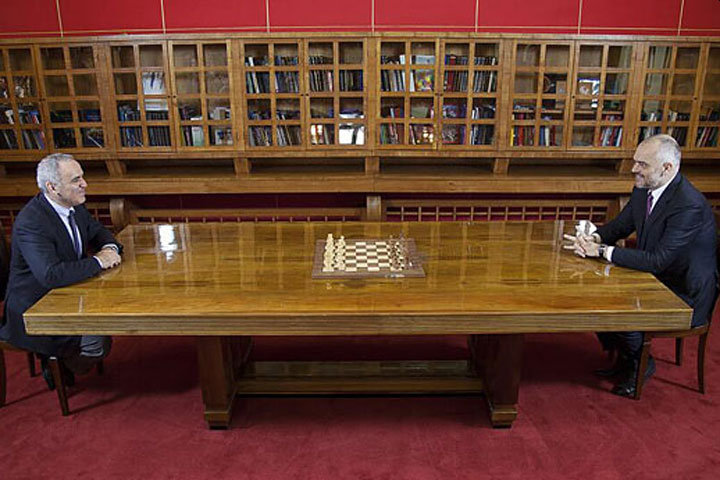 New chess table to ensure security (1/4/2020) – We reported that Garry Kasparov had launched a project called "Corochess", introducing a new chess table that would enforce full social distancing during the pandemic. The board was Alexa or Google Assistant driven: you speak the moves, and they are automatically executed on the board in the middle of the table.
This April 1st jest seemed, at the time, a little inappropriate – unless you agreed with experts who told us that it was important (including for our immune system) to keep our spirits up during the global pandemic crisis.
On April 1st 2022 we took a step further into the realm of tastelessness, and described a new wartime development.
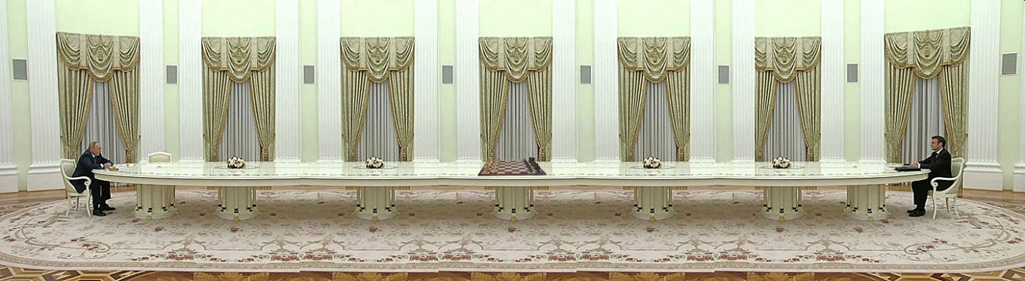
Here, we said, was an improved chess table designed by a Russian leader Vladimir Putin. The inventor is apparently worried about his safety, and fears physical attacks by his opponents. The idea is to keep as much distance as possible between the players during the games. Naturally, we had engaged in a little Photoshopping to generate the picture.