Frederic's chess tales - Part one
Darkness on the Horizon
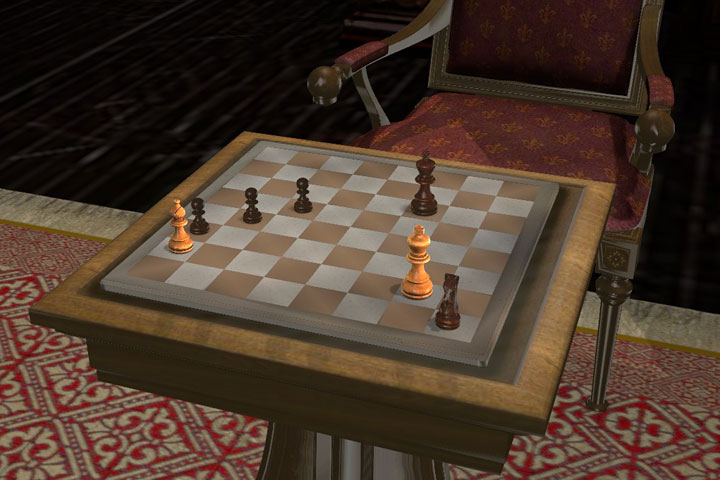
Take a look at the position in this picture. How can White draw? Impossible, of course: you can capture the knight, but then the black king moves to d4 and the pawns win the game.
However, against early computers, there was a way to save this position. In an historical article, written decades ago, I described how computers at the time could fall into the horizon trap. Let me explain the concept.
Imagine that you are travelling by car and have a breakdown. It's the middle of the night, and it's completely dark. You are in a rural area, but fortunately you can see a light in the distance. It is obviously a house where you can get help or at least make a phone call.
You take the small flashlight that you always have in your car, and set off. But you don't get very far because soon you see a nasty-looking fence in the beam of your torch, two meters high and covered with barbed wire. It blocks your way to the house. Of course, you could try to climb over the fence, but you'll probably tear your expensive suit and break your neck. On the other hand, you can't possibly spend the whole night outdoors.
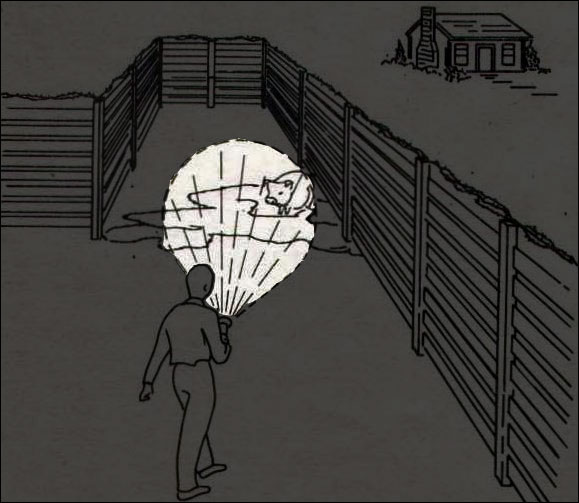
So what do you do? You shine your flashlight to the left and to the right, but everywhere the fence seems to continue. In front of you, you suddenly see a gap in the fence. It is clearly a passageway through which you can easily get to the house. But not without a few problems. Directly in front of the gap you can see a big mud puddle in which a pig is wallowing. You have to wade through this puddle if you want to get to the house. That will certainly not do your suit any good, and you will certainly not smell like a rose when you reach the house. But at least it's better than having to climb over the fence.
So you hold your nose and walk bravely through the mud. You get to the other side and breathe a sigh of relief. That's all over, you can get to the house that will save you. But now you can see in the light of your flashlight that the fence had no passage, but only a small indentation.
Unfortunately, the passage through the puddle did not help, you have to climb over the fence. Besides the torn suit and possible injuries, you have also dirtied yourself with mud, which was completely unnecessary. If you had a better flashlight, this wouldn't have happened. You would have seen for sure that crossing the puddle was useless. And you might have discovered that there's a gate to the left through which you could have simply walked...
 This nice little story is taken from a book about chess computers (Julio Kaplan: "How to get the most from your chess computer", R.H.M. Press/Pitman, 1980).
But what does the story about the fence and the puddle have to do with computer chess? Well, it illustrates in a catchy way the phenomenon known as the "horizon effect". Computers get into situations not unlike the one described above.
In the early days of chess programming, computers were quite short-sighted and easily fell victim to the horizon effect. We had a lot of fun with that. Take a look at the following drastic position I devised almost forty years ago:
Black, as you can see, wins easily by simply giving up the rook. Today’s programs will tell you in a second that e.g. 1...f5 results in a mate in 14, or 1...e5 mate in 15.
But with the programs at the time, you would experience stranger things. Many gave away the win in the foolish attempt to save the rook: 1...f6 2.Bxf6 e5 3.Bxe5 d4 4.Bxd4 c3 5.Bxc3 and now the position is a draw.
It was cruel to make fun of early computers, but I could not resist. Here’s position I used to test the ability of 1980s computers to avoid the horizon trap:
At the time I used the position on commercial chess computers and commented my results ironically:
1.Kxhl? Is a clear mistake. It leaves the computer no other option but to destroy you: 1...Ke5 2.Kg2 Kd4 3.Bg8 c4 etc. But can you achieve a better result?
Yes you can! We have to simply take advantage of the horizon effect and subtly deceive our electronic friend. We play a very precisely calculated move: 1.Kf3!! You probably won't believe it, but only with this nonsensical move we had a chance, at the time against chess playing computers, to save the position.
The computer would start to calculate. It would first consider 1...Ke5, but soon it would realize that the opponent can then threaten and capture the black knight with 2.Kg2. It doesn't want to give it up (the fact that we spurned the knight one move before has of course no meaning for the computer). So it quickly hatches a clever plan to "save" the knight: 1...c4? With this move it has pushed the loss of the knight beyond its calculation horizon. The knight remains in play, for which the computer gladly gives up a pawn.
Now you can also see why 1.Kf3 was important. Had we captured the knight, 1...Ke5 would have come, of course. And if the king had stayed at g2, the computer would have quickly realized that it would lose the knight anyway. It wouldn't have bothered about it at all, and it would have won the game ice cold.
But we have not yet solved all problems: 2.Bxc4 Ke5! Obviously the computer wants to attack the bishop after 3.Kg2 with 3...Kd4 and thus "save" the knight again. Since this also happens to win, we have to play carefully and once again lead the opponent away from the right path: 3.Bg8! Again, it wants to continue correctly with 3.Kd4, but then discovers that the knight is in danger, and tries to save it again: 3...b3? The trick worked, we have a draw: 4.Bxb3 Kd4 5.Kg2 etc.
Today’s computers are far more sophisticated, and tricking them with the horizon effect is almost impossible. We look back with nostalgia to the days when we were superior to the electronic upstarts and could trick them with impunity.