Frederic's chess tales - Part one
Nigel Short and the chess player's brain
In the late 1970s I was a science journalist, making documentaries for German television. One day, I suggested to my boss that we make a documentary on how computers could play chess. It was very successful, and the other German channel asked me to do a similar report.
For the second documentary we decided to concentrate on the difference between human and computer thinking. For that, we needed subjects to experiment with. I invited a young boy — a very talented young boy — to come to Hamburg and to play in a tournament which was going to be staged there. His parents agreed to send him alone, since I volunteered to put him up in my house and look after him. He had just turned 15, and I arranged for Lufthansa to chaperone him when he had to change planes at the airport in Dusseldorf. When I picked him up in Hamburg I looked around for a little boy, but was greeted by an almost six-foot tall lad. This was the teenage Nigel Short, with whom I did a lot of filming and a lot of experiments. He became a family friend and returned to visit maybe 20 times. It was always a great deal of fun. I have described it all in this video interview.
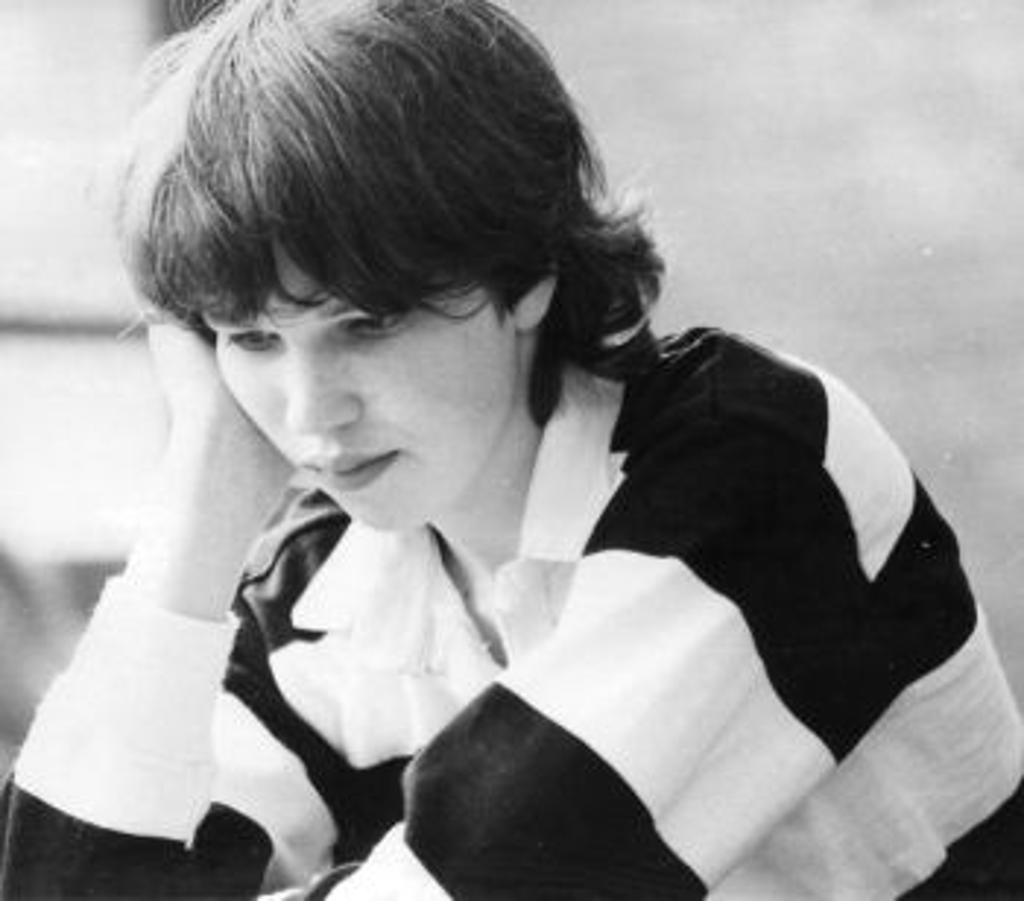 As a 15-year-old, Nigel looked quite effeminate, and he would sometimes go to the tournament with a teddy bear, which he would put it on the table, next to the board. His opponents, Eastern European grandmasters, found this very disconcerting. They didn’t know what they were facing – a child, a boy, a girl? In one case Nigel even wore a thin silk blouse he borrowed from my wife. I could see his opponents wondering whether they should be trying to look down the front. But of course they soon discovered that Nigel was in fact a very, very strong chess talent. A little over a decade later he became a World Championship challenger.
There was one incident in this 1981 tournament which has stuck in my memory. In round six Nigel had outplayed Bulgarian grandmaster Ivan Radulov, reaching the position shown below. The only reasonable course of action for Radulov would have been to resign. Instead, assuming that his young opponent was fairly inexperienced, he tried a clever little trick.
Radulov played 38...Qf3 39.Rxd7 Qd1+ 40.Kg2. The moves were executed swiftly, as if Black had seen some kind of perpetual check. And now came the trap: 40...Qe2+?! Naturally Nigel was expecting his opponent to deliver the next check on d2 or c2, and he was all set to play 41.Kh3. Had he done so mechanically, he would have lost the game.
Nigel did not fall for the trap. When he saw what his opponent had done, he punished him in an amusing way. He went into a deep think. There was a crowd of spectators watching the game, and everyone began to laugh. Radulov could only grin sheepishly and stick out his hand in resignation. Nigel played 41.Qxe2 before he accepted. It wasn’t easy to trick the lad.
For the second TV documentary on chess playing computers, I did a fair bit of research on how the human brain processes the game of chess. I visited the Dutch scientist Adriaan de Groot, who was the world's leading expert in the cognitive analysis of chess masters. In the 1940s, 50s and 60s he had conducted tests and described his results in a famous book, Het denken van den schaker. De Groot helped me to design the experiments we would conduct for the documentary in Hamburg. He was a very interesting person, and I am thankful until today for all the things I learned from him.
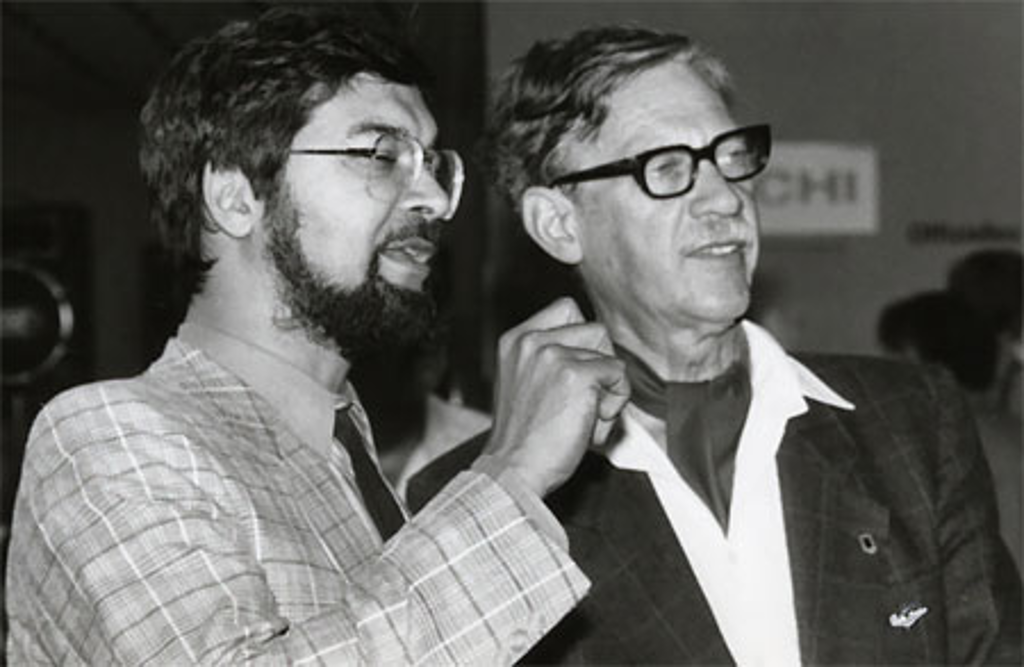
Adrianus Dingeman de Groot, commonly known as Adriaan de Groot, conducted his chess experiments on players from many different backgrounds, all the way from rank beginners to strong grandmasters. His goal was to explain how chess experts could grasp a full board position, assess the situation, find constructive ideas of what to do next, and in fact find good moves, all within seconds of being confronted with the position.
In his experiments, the participants were required to look at a chess position, while expressing their thought processes verbally, while a researcher recorded them. De Groot's most startling result was to show that in grandmasters most of the processes that went into finding a good move occurred during the first few seconds of contemplation of the position. He defined four stages of the thought process:
- The orientation phase – here the strong chess player grasped the position and formulated general ideas of what to do.
- The exploration phase – this was characterised by the analysis of concrete variations.
- The investigation phase – where the strong player actually decided on a probable best move.
- The proof phase – here the subject spent time in confirming the validity of the choice reached in phase three.
Drawing on earlier studies (by Djakow, Petrowski and Rudik in the 20s) de Groot exposed subjects very briefly, for 3-4 seconds, to positions taken from a game. He found that grandmasters and masters were able to recall the location of 93% of the pieces, while the experts remembered 72% and the class players merely 51%.
I could confirm much of what Adriaan told me in experiments with Nigel, who became a prime research candidate. My experiments would proceed as follows: I would set up a position on the dining table and then call Nigel, who was typically strumming a guitar in the living room. As he approached I would, stopwatch in hand, watch his eyes. As soon as they hit the chessboard, I would start the watch, and the moment he reacted – said anything – I would press “lap.” If it was “You want me to look at this position?” I would let the watch continue, until he said something position-specific, like “doesn’t bishop takes pawn win?” Then I would stop the watch. I discovered that it took Nigel between five and twenty seconds to solve most tactical problems I set up for him.
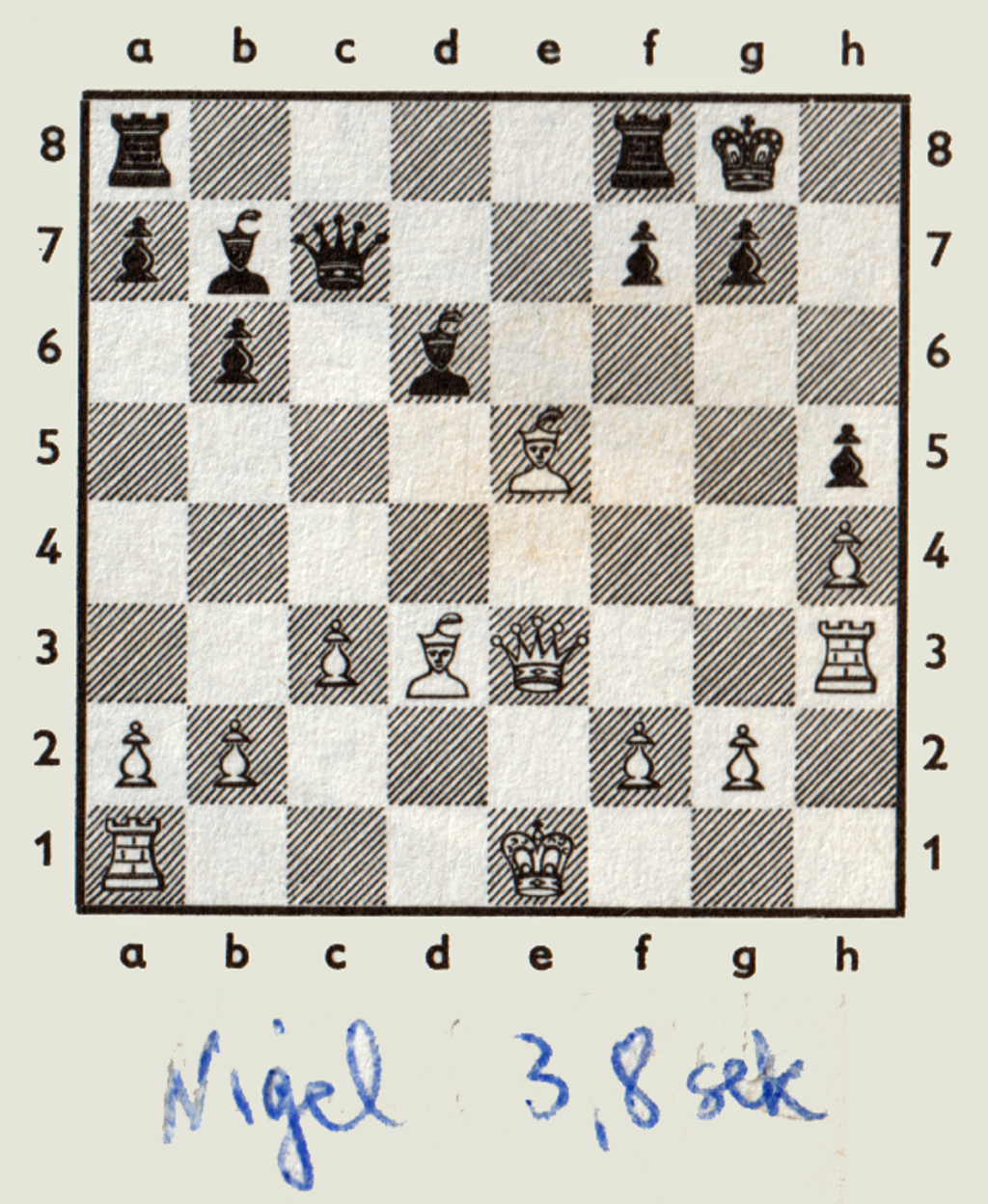 I would also use chess books, showing Nigel a position (while covering the solution with a thumb). This picture is from a book I still own, where I noted that Nigel found the key, Qh6, in 3.8 seconds.
I also tested his honesty. I would occasionally set up a position I had shown him a year earlier. He would inevitably say “Hang on, haven’t you shown me this before?”
While conducting the experiments, I discovered something remarkable. Sometimes the reaction came in less than one second: Nigel would recognize a once-seen position almost instantly. I told some researchers in the psychology department of the University of Hamburg about this, and they explained patiently that what I was describing could not possibly be correct: it was cognitively impossible for a human being to identify a chess position, with over twenty pieces on the board, in less than a second.
And they started to analyse — me! They told me that it was common for researchers to exaggerate their findings, out of pure enthusiasm for the subject material. It was clear that I had not been timing Nigel accurately. So I invited them to come over to my house and test the lad themselves. This they did, bringing a chess savvy psychologist along, and ran tests on the lines described above. They showed Nigel positions from obscure East German games and asked him to find winning moves. He did that in seconds, and they spent the afternoon wondering if there was some trick involved. According to their understanding of the cognitive functioning of the brain, Nigel could not have done what he just did. A group of bewildered scientists left my house.
To the scientists and the TV audience I tried to explain that Nigel was not scanning 24 (or more) pieces. He was seeing five or six “super-pieces” on the board. These are clumps or configurations that make sense.
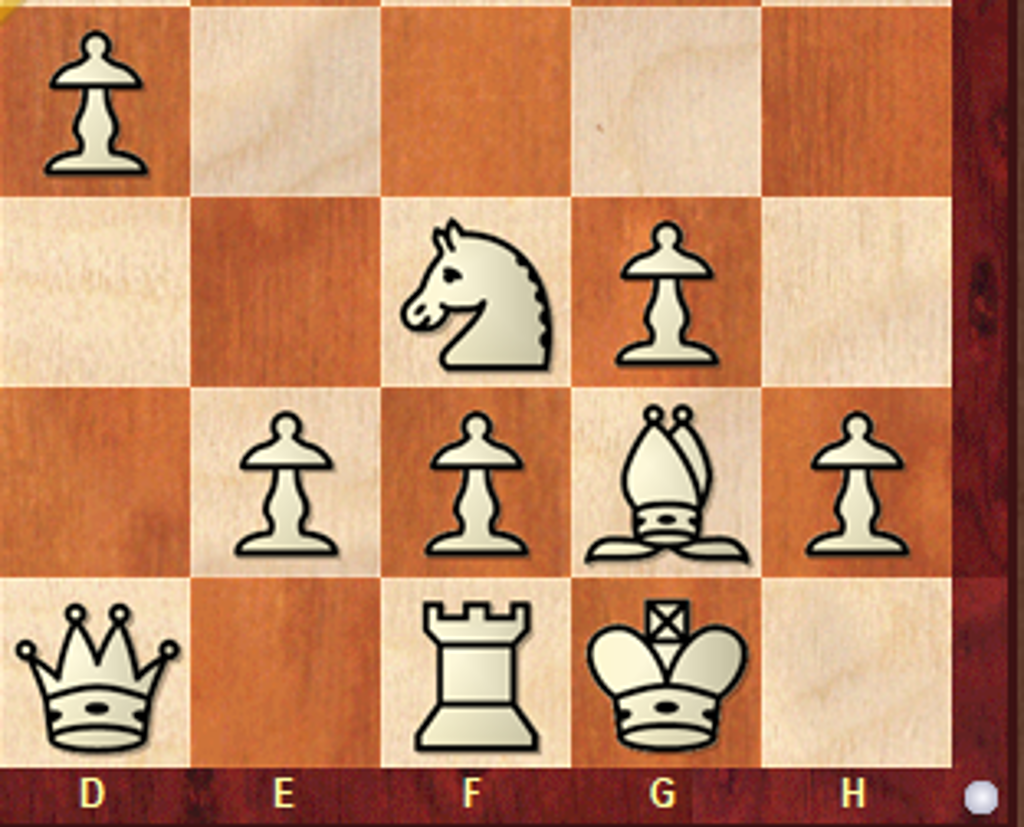 The ten pieces here do not need to be individually scanned – a single glance will tell the master it is a “fianchettoed bishop in front of a castled king”, and that it came after a 1.d4 opening. The master sees this instantly, and equally quickly draws conclusions: the knight is defending the d-pawn, the bishop is potentially defending the e4 square, as well as attacking b7 and the rook on a8, etc. Very strong chess players have a “vocabulary” of tens of thousands of such chess words, which they recognize and employ with great virtuosity.
So what is it like for amateur chess players to be confronted with the same task? We showed absolute beginners the same positions that Nigel had solved in seconds, and in fact used an optical scanning device to track their eye movement. They were indeed looking at all the individual pieces – and seeing nothing. And they could not solve the tactics.
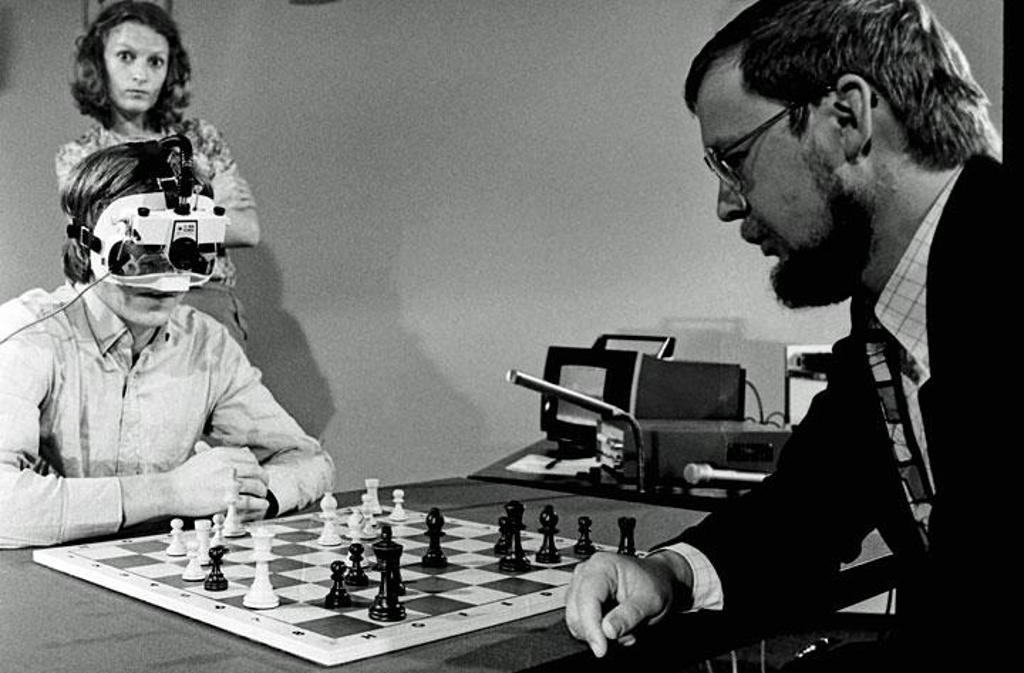
On the other hand, the eyes of World Championship candidate András Adorian moved around the board in general, pausing on piece clusters, but also on empty areas. In one experiment (picture) he said: "This is very easy!" and proceeded to execute the combination, in which at one stage he used the a1 rook, which he had never directly looked at!
In addition we gave András random positions with no chess meaning (e.g. with pawns on the first rank, the white king somewhere in the middle of enemy pieces) to look at for five seconds. Then we asked him to reconstruct the position on a separate board. The result: he got just five or six pieces right, almost exactly the same number as rank amateurs were able to remember from meaningful chess positions.
To make all this clearer to my audience, I conducted the following experiment: I told them to watch the screen, where I would flash 26 letters of the alphabet for five seconds. After that, they were to write down as many of the letters as they could remember. Then I flashed the following on the screen:
The postman came and delivered
Of course, the audience did not need five seconds to memorize all 26 letters and their positions. They could do it immediately, and flawlessly. The reason was that they were not memorizing individual letters, but words. I then asked them to “complete the sentence.” They immediately came up with meaningful suggestions: “... a letter”, “... a parcel,” etc. And I praised them for being “grandmasters” of language. What they did was similar to what Nigel was doing on the chessboard.
To give the audience an impression of what chess felt like to an amateur, I flashed the following string of letters on the screen for five seconds.
Postimies tuli ja toimitti
This time they could only memorize a few letters, like “Post” and “tuli,” and they certainly couldn’t complete the sentence – which was in Finnish. They were in the position of a chess amateur, who could only remember five or six pieces, and didn’t have a chance of finding the winning move.
With Nigel I also attempted to test one of my pet theories: that very strong chess players use mainly the right hemisphere of their brains to play chess. That is the half that specializes in visual and intuitive processing, the half that is (usually) responsible for recognizing objects or faces. The problem with testing this hypothesis is that you cannot get a player to play games using only one half of his brain, and then a set of games using the other half for comparison. I tried using restricted vision: I prepared glasses that covered one half of your field of vision, and then the other (your eyes are wired so that one side of the retina of each eye sends signals to one half of the brain, while the other half sent them to the opposite side).
I made Nigel play very fast blitz games against a strong player. The theory was that if the games were fast enough his corpus callosum, the 200 million nerve fibres that connect the two hemispheres of the brain, would not have time to pass the information from one side to the other.
Unfortunately, Nigel scored equally well with glasses blocking the left and the right halves of his visual field: he won all the games. In a separate experiment, I made him play against the same player blindfolded, and he again won all his games. So it was just that he was so much stronger and didn’t need to see the board to win.
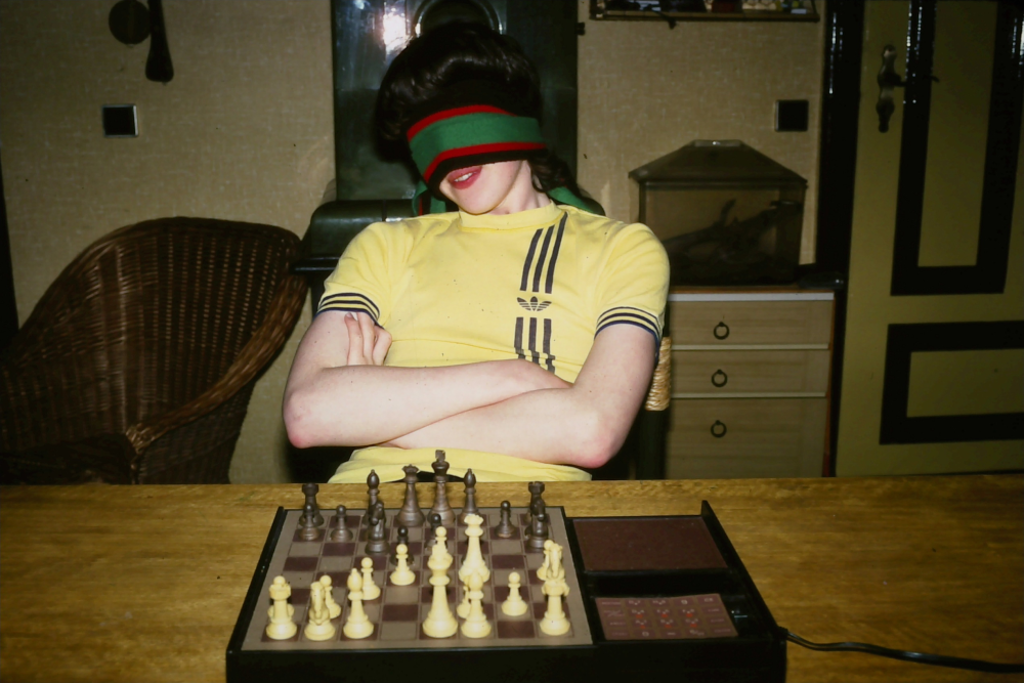
against one of the strongest chess computers available at the time.
So my theory has remained untested – especially since all my grandmaster friends positively refused to have their corpus callosum severed, a controversial procedure that in the past was used to treat mental disorders. That would have cleared up the matter for me.
Still, my experiments with Nigel remain instructive and illuminating for me to this day.