Frederic's chess tales - Part one
Puzzles on a train
Recently, I was on a train trip — a four-hour journey. Trains in Germany have nice tables with four seats around them, and mine was shared with two young boys, one around twelve and the other in his late teens. They had a nice little wooden chess set and were playing a game. I watched and saw that they were fairly rank beginners. The younger boy, Andreas, won the game — by not overlooking a chance to mate in one. He wanted another game, but his brother balked and started to occupy himself with his mobile phone. The lads were bored. I thought maybe I should offer to play Andreas. But then I had a different idea.
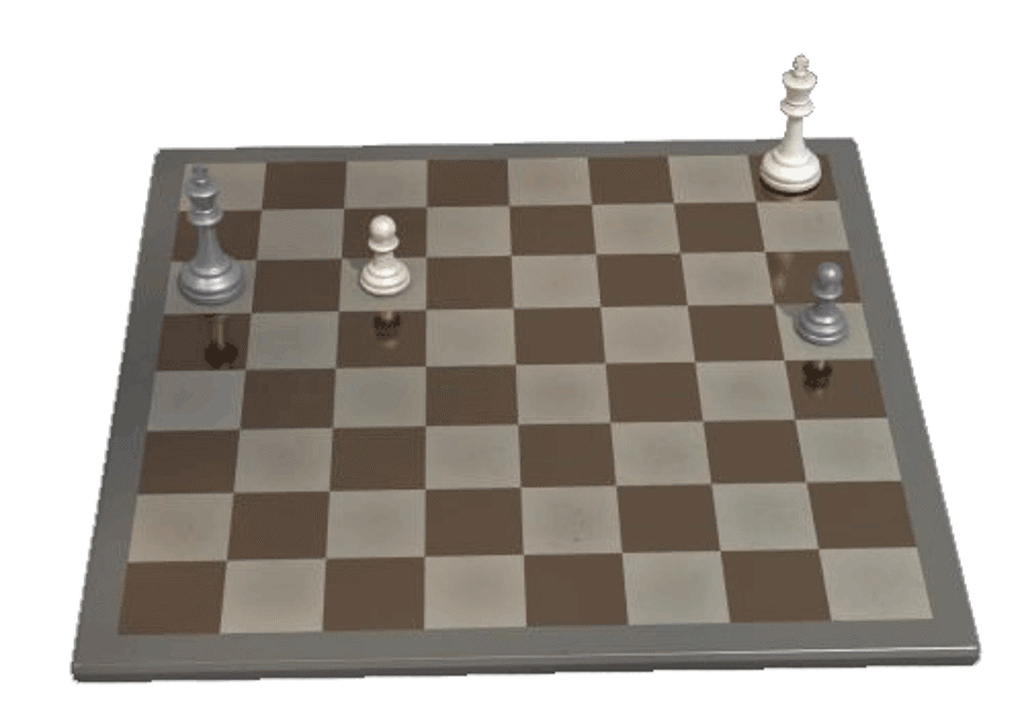 "Here, let me show you a little problem," I said to the younger boy. "Tell me if you know it.
Andreas did not know it. I told him it was a famous "study," composed by a very strong chess champion, Richard Réti, almost exactly one hundred years ago. The requirement was that White would start and force a draw. After making sure he knew which way the pawns went (the black pawn moves downwards), Andreas started to move pieces on the board, trying to find a way to save the game for White. After a couple of minutes he said, emphatically: "It is impossible, Black can always win."
Now this is the way you can get the attention of novice chess players: I did not tell Andreas the solution, or even offer any hints or help. I just sat back and complacently repeated: "White can draw!" Suddenly his brother, who didn't want any more chess, had joined in, and the two boys started working on the problem systematically. Which meant they tried to catch the black a-pawn with the king. But Kh7, h6, h5 failed to work — the pawn promoted to a queen. So they tried to find a way to promote the white pawn, but Black always prevented that.
In the end they reached the conclusion that it was completely hopeless: Black can always win, you can see that at first glance! But I stuck with my demand. Finally, they gave up and asked me to tell them "the trick." The older boy even considered the possibility that the way was to pull out a baseball bat and threaten the black player, forcing him to accept a draw.
"Okay," I said, "if Black can always win, try to do it against me." They started moving the pieces for Black, and were not able to do it. They tried again and again, and each time I was able to hold the draw. Now I explained the "Réti manoeuvre" to them. I told them how moving a king to chase the pawn did not have to be straight down the file, but could go diagonally just as fast. And that could be used to and follow a dual purpose: to chase the black pawn and at the same time approach and threaten to defend the white pawn.
This famous Richard Réti, Kagan's Neueste Schachnachrichten 1922. On the diagram you can play white moves – the board will reply for Black, trying to win.
And here is the solution: if after 1.Kg7 h4 2.Kf6 Black plays ...h3 White can change course and head for his own pawn: 3.Ke6. That ensure its promotion. If Black tries 2...Kb6 to eliminate the pawn, White can simply continue: 3.Ke5!, and if the black pawn then continues with 3...h3 White can change course here, playing 4.Kd6!, ensuring the white promotion. Try as they might they could not prevent me from defending the c-pawn — unless they spent two king moves to capture it, in which case my white king would catch their pawn.
The point of this rather lengthy and detailed narrative is that these boys, in less than half an hour, had learnt something important about chess: that the game is not just about "stealing" (they used the German word "klauen) the other player's pieces; you can, in fact, do very clever things to succeed. You should have seen the pure joy on their faces when they had understood the Réti position fully. They couldn't stop grinning, and they asked for more. So I gave these young boys another Réti to solve:
Try as they might they could not solve this one either — who would think that the white king must go after the g-pawn and allow the f- or h-pawn to proceed towards promotion. But after I showed them 1.Kg6 h5 2.Kxg7 h4 ("That's rubbish, the black pawn promotes") 3.Kxf6 the older boy let out a colossal shriek: "It's the same as the other problem!" And he showed me how White can support his pawn, or stop the black one. The look on both faces was even more full of pride and joy.
German Rail thankfully has Internet, so I could use my mobile phone to find more positions, ones I did not have in my head. Here's the next puzzle I gave the boys and discussed it with them:
I told them who the players were, and how Siegbert Tarrasch was convinced that he was winning against World Champion Emanuel Lasker. But the latter found a Réti-like manoeuvre to save (and almost win) the game. We worked it out together and, although it is not trivially easy, in the end the boys understood everything perfectly, even the unlikely second move (why doesn't the more likely one work?). They actually found everything by playing the position out against me.
You, dear reader, can do the same, either by using a board and pieces, or by moving the pieces on our diagram. Or go to the replay board at the end of the chapter for the game and full analysis.
So here’s how Lasker saved the very dangerous position against Tarrasch: 40.h4! Kg4 41.Kg6!! Black overlooked this powerful move. As in Reti's study, White's king both helps his own pawn and fights against Black's pawns at the same time. Now Tarrasch barely draws. Note that if White had played 41.Kf6? he would have lost: 41…c4 42.bxc4 bxc4 43.Ke5 c3! 44.bxc3 a4 45.Kd4 a3 and the white pawn on c3 prevents the white king from moving into the pawn square a3-c3-c1 to stop the black pawn from promoting.
41...Kxh4 42.Kf5 Kg3 (42...c4 43.bxc4 bxc4 44.Ke4 c3 45.bxc3 a4 46.Kd3 a3 47.Kc2 draws. 43. Ke4 Kf2 44. Kd5 Ke3 45. Kxc5 Kd3 (45...b4?? 46.Kb5 Kd4 47.Kxa5 Kc5 48.Ka4 Kc6 49.Kxb4 actually wins for White!}) 46. Kxb5 Kc2 47. Kxa5 Kxb3 1/2-1/2.
We went through a few other similar positions, including one from a study that has been my favourite for many years:
Here the problem was: White cannot simply promote, because of the bishop skewer: 1.c8=Q? Bf5+ 2.Kc7 Bxc8 wins for Black. If White tries 2.Kd6 Bxc8 3.Kc5 Ke4 4.Kb6 Kd5 the pawn on b7 will once again not fall — Black will simply use his king to accompany it to promotion.
So my question was: in the diagram position, which is the most unlikely move that White could play? You can try to find it by moving pieces. Black will defend and force a draw – unless you find the correct solution.
The boys thought about 1.Ke6 Ke4 (now the skewer on f5 still works) 2.Kd6 Bf5 3.Kc5 Bc8 and we have the same situation. The boys spent quite some time trying, but moving for Black I was able to always win. They came to the conclusion that there was no possible way to draw.
"Think Réti," I said, and with a little prompting they actually found the solution: 1.Kc8!! b5 2.Kd7! b4 3.Kd6 Bf5 4.Ke5 Bc8 5.Kd4 draw. That is sooo cool!" Andreas said, and both spent many minutes just raving over the problem.
Below is a replay window with all four positions from this chapter. You can replay all the lines, and even start a chess engine (fan icon) to answer any “what if” or “why not” questions you may have.