On my news page, and in this book, I did an article on Retro Chess, purely for entertainment. Amongst the many letters I received, one was particularly gratifying. "I was very pleased to read the article — simply entertaining, because I have been occupied with the subject for 50 years." It was from the former Mayor of the town of Meisenheim, located near Frankfurt, Germany. His letter and subsequent gift were quite invaluable. We will tell you why.
Retro Chess revisited
 The letter came from Werner Keym, who is a teacher (of French and Latin) and a musician who has organised more than 300 concerts in his town. Then, in 2010, he ran as an independent candidate for Mayor of Meisenheim and won in a landslide. He held that position until 2014, when at 72 he retired to devote more time to his family — he has five grandchildren — and to his hobbies. The foremost of them is problem chess.
Werner Keym is one of the most creative problemists I know. He specializes in problems involving castling, en passant captures and pawn promotion. For many years I have enjoyed his problems, which I often encountered. Many have the advantage of not being prone to instant solution by chess engines. They force you to think.
Together with his letter, Keym sent me a signed copy of his most recent English language book, "Chess Problems Out of the Box". It is going to keep me busy for a long time to come. It is one of the most entertaining works I have ever encountered (and it is competing with Loyd, Dawson, Fabel, Smullyan and co.).
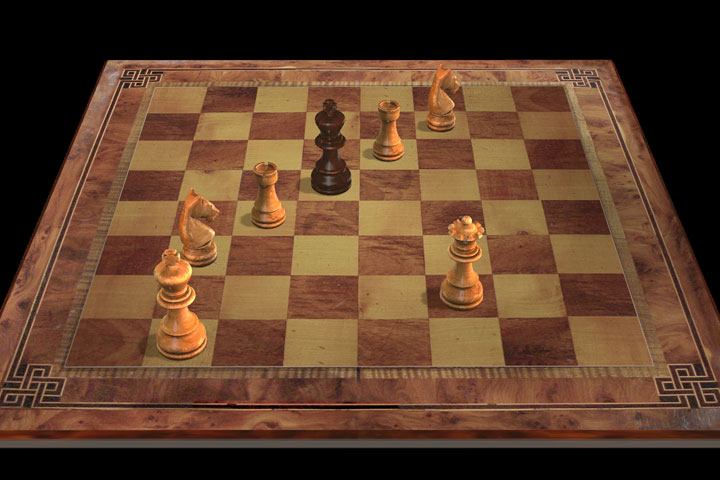
Here we see position 271 from his book:
Mate in two moves.
It is an elegant miniature and one of Keym's favourite problems. It was published on the occasion of his 60th birthday.
At the time, 223 readers of 237 got the solution wrong: 1.Rb6? is not possible because Black could not have made the last move. So it must be his turn to play. I have added the solution in the game viewer at the end of this article.
Castling problems for you to solve
To provide an impression of the book I give you the problems of the first two pages (click to enlarge), devoted to castling problems.
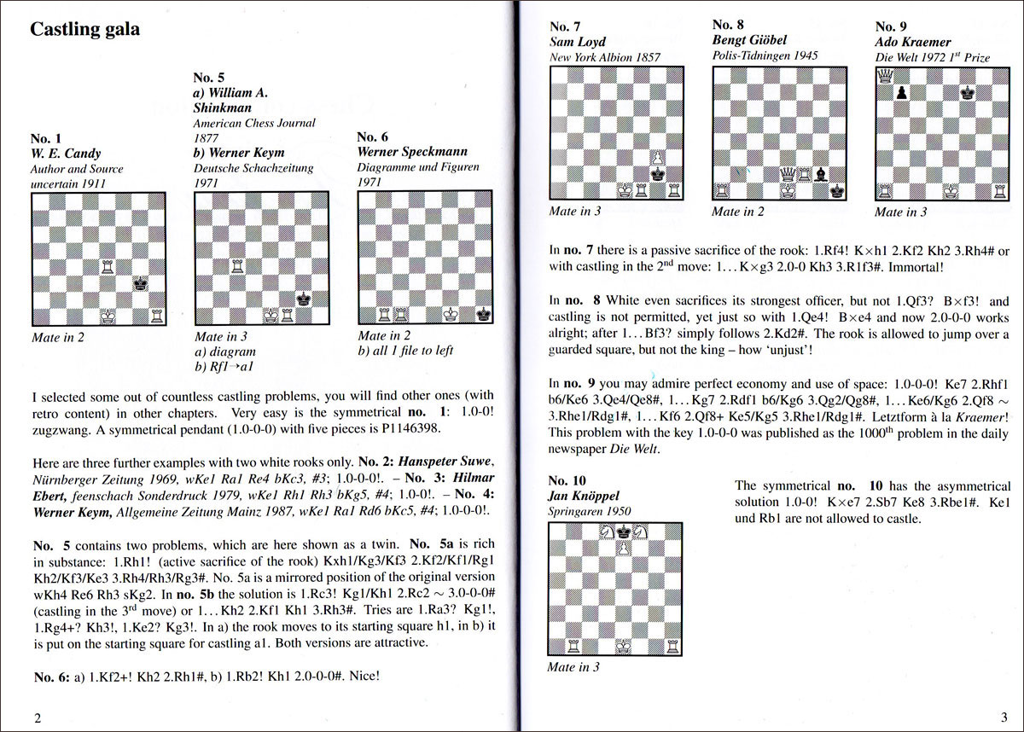
Remember there are 167 more pages, densely filled with unusual and tongue-in-cheek problems. Don't take my word for it; go buy a copy of Chess Problems out of the box — it's just €10 / US $12 (plus €2/$4 for postage). Outrageously good value for money.
Castling for fun
The first six problems have minimum material: just the two kings and two white rooks. They are simply fun to solve, and quite easy, since we know that castling is involved. Please try to find the solutions by moving the pieces on the diagrams (the engine will defend for Black) before you proceed to game viewer at the bottom of this article.
The next set starts with a charming twin — clearly, only one position involves castling. The Loyd problem is absolutely classic and will never be forgotten (try solving it, and pat on the back if you succeed). Giöbel is fairly subtle. Think for a moment before you decide on the solution. And recognize that our live replay diagrams understand the castling rules. Kraemer is elegant and astonishing, while the symmetrical Knöppel is asymmetrical due to castling.
Please do try to solve as many problems as you can without looking at the solutions below. That is the only way one can really enjoy them. The problems are not so hard — I solved most of them directly on the pages of the book. Also please tell us what you think of this area of chess. Do you find it entertaining and enjoyable? Should we continue bringing you unorthodox chess problems?