Here’s a little puzzle that has been with me for decades. It is deceptively simple:
Can you imagine anything simpler? After the initial pawn move, you have to find a sequence of just five moves that allows the game to end with a knight taking a rook and delivering mate. You can try it on the above diagram. Warning: I will not be giving you the solution at the end. You have to find it yourself.
The puzzle is unexpectedly difficult, and has a lot of stories surrounding it. Originally it was given to me by Dr John Nunn, mathematician, grandmaster and problem specialist. John sealed the answer in an envelope and asked me to return it unopened, with the solution written on the outside. Together with Ken Thompson, inventor of Unix and the computer language C, I spent a number of hours trying to solve the problem (and Ken spent half an hour trying to read the contents of the envelope over a bright light). In the end, we tore the thing open and admitted humiliating defeat.
That was just the beginning. A short while later I was accompanying Garry Kasparov and Anatoly Karpov to a meeting with the president of the World Chess Federation, FIDE, in Switzerland. It was 1986, during the turmoils after Kasparov had won the world championship and was being forced to face an immediate rematch against the dethroned champion Karpov. We were on a long car journey together from Zurich to Luzerne. It was hot, and they were tired. In an attempt to distract them, I gave them John's puzzle.
“Come on, Fred,” Garry said, “who has time for this kind of stuff.” And both sat there, staring sullenly out of the car window. After a while, Garry suddenly said: “Is it five moves after 1.e4?” To which Anatoly immediately commented: “Of course not, otherwise there would be many solutions.” They had been thinking about the problem!
We spent a few days in Luzerne, negotiating with the FIDE President. On the final day Garry came to me and said: “Fred, you have occupied the minds of the two strongest chess players in the world with your silly little problem. I am convinced it has no solution. I want you to go into your room and play it out on a chessboard. Confirm that it actually works.”
“Okay,” I replied, “but in return you must go up to your room and check your passport. I want you to confirm to me that you are really Garry Kasparov.” We both proceeded to our rooms, and afterwards met in the hotel lobby. Garry confirmed that he had checked and was indeed Garry Kasparov, and I confirmed to him that I had played through the moves: the problem was sound.
Before we parted, I did the Nunn thing on Garry: I sealed the answer in a hotel envelope and told him to return it, unopened, with the solution written on the outside.
I didn't hear from Garry for some months. Then one day I came home and found a number of messages, with a phone number where I should call Kasparov, urgently. I did so and found him in a distraught state. "You are a dead man, Fred," he said, "you have put me in a very embarrassing situation." It turned out he was running a session of his chess school, together with former World Champion Mikhail Botvinnik, and he had given the problem to his students. When they couldn't solve it and asked him for the answer, he had told them it was important that they should never give up so easily. They must think about it for one more day. Meanwhile he tried to find the solution himself, and when he did not succeed, he called his home in Baku, instructing his family to search for the envelope. Unfortunately, it could not be found. So the only way left was for him to call Fred.
When I told him the solution on the phone I could hear Mikhail Botvinnik gasp in the background. And Garry, who solves the most complex chess positions in his mind, while strolling through the street in Paris (I have written about that elsewhere in this book), couldn't believe that he, Botvinnik, and his students had not been able to find the unusual sequence of moves.
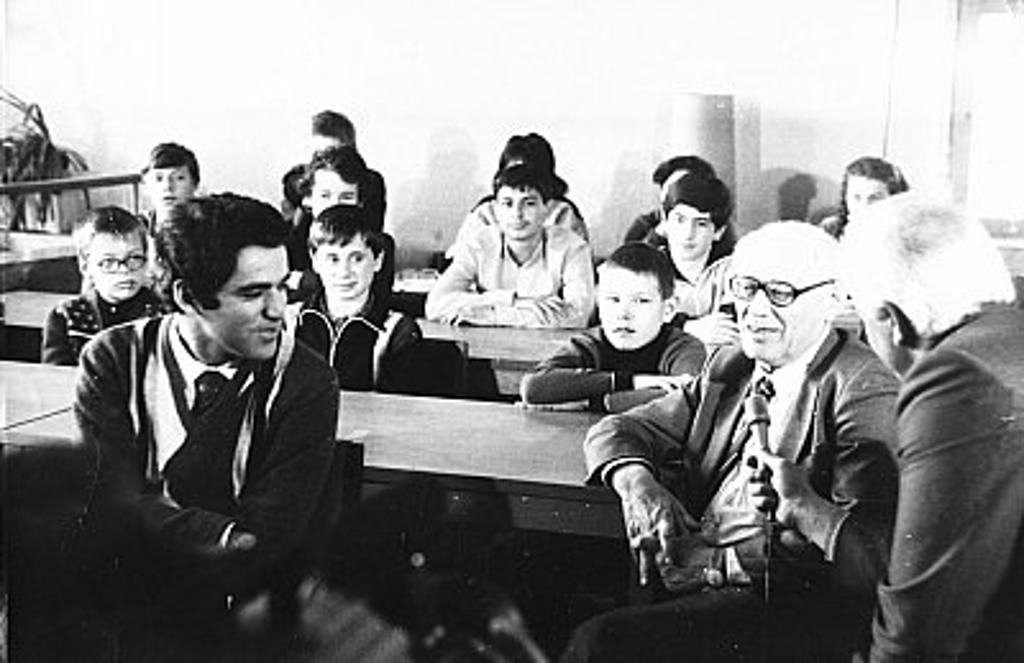 Another little story? I was telling the above to Vishy Anand and Vladimir Kramnik, a few years later, in a little restaurant in Wijk aan Zee. They listened bemused, thinking that I was probably adding a lot of journalistic embellishment to the whole story. But then suddenly a grandmaster, sitting at the adjacent table, came over to us and said, "Are you talking about a problem which Kasparov gave his students, back in 1986? I was one of the students!" The grandmaster was Boris Alterman, now grown up and himself a world-class player.
Subsequently Boris sent me this picture. It was taken during the 1986 Botvinnik School, when the above transpired. The picture shows Garry Kasparov and Mikhail Botvinnik (being interviewed) in the front, and the youthful Boris Alterman, sitting in the middle of the picture in the second row of students.
In 1999 I published the problem in the Christmas puzzle week on the ChessBase news page. There were scores of letters, many with erroneous solutions, like 1.e4 d6 2.f4 Nf6 3.Kf2 Ng4+ 4.Kg3 Nf2 5.Nf3 Nxh1+ (unfortunately White has 6.Kh4, and the final position is not mate) or 1.e4 d6 2.Nh3 f6 3.Nf4 Kf7 4.Ng6 Qe8 5.Nxh8+ (the king can escape: 5...Ke6).
There were a few correct solutions. Richard Meisel wrote: “Finally! Absolutely amazing! I've spent weeks looking at this problem. I must have tried every possible position NxR could have occurred on the 5th move and was convinced it was impossible. The solution is mind-boggling.”
I never published the solution on our news page, and to this day, more than thirty years after I published a report on this problem, I get messages imploring me to reveal it.
What the heck, I’ll give you the solution. But it will be hidden somewhere else in this book.