David Cope is an American professor of music at the University of California experimenting with artificial intelligence and music composition. He has written programs that analyse classical music and then compose pieces in the style of that music.
On his home page we find a description of how he began his experiments in 1981. His initial was to create a computer program which would have a sense of his overall musical style and the ability to track the ideas of a musical composition at any given point, so one could request a next note, next measure, next ten measures. His programs composed complete works in the styles of various classical composers.
I could write an extensive description of the work Cope embarked on, but this has been done in superb fashion by Yuval Noah Harari in his book Homo Deus: A Brief History of Tomorrow. If you haven’t read that book, order it today, together with the first part, Sapiens: A Brief History of Humankind. They are possibly the most important purchases you will make this year. Harari writes (given here in excerpts):
David Cope has written programs that compose concertos, chorales, symphonies and operas. His first creation was named EMI (Experiments in Musical Intelligence), which specialised in imitating the style of Johann Sebastian Bach. It took seven years to create the program, but once the work was done, EMI composed 5,000 chorales à la Bach in a single day. Cope arranged a performance of a few select chorales in a music festival at Santa Cruz. Enthusiastic members of the audience praised the wonderful performance, and explained excitedly how the music touched their innermost being. They didn’t know it was composed by EMI rather than Bach, and when the truth was revealed, some reacted with glum silence, while others shouted in anger.
You can listen to EMI Bach chorales, and to Vivaldi, Chopin, Beethoven, and others on this page.
Professor Steve Larson from the University of Oregon sent Cope a challenge for a musical showdown. Larson suggested that professional pianists play three pieces one after the other: one by Bach, one by EMI, and one by Larson himself. The audience would then be asked to vote who composed which piece. Larson was convinced people would easily tell the difference between soulful human compositions, and the lifeless artefact of a machine. Cope accepted the challenge. On the appointed date, hundreds of lecturers, students and music fans assembled in the University of Oregon’s concert hall. At the end of the performance, a vote was taken. The result? The audience thought that EMI’s piece was genuine Bach, that Bach’s piece was composed by Larson, and that Larson’s piece was produced by a computer.
Ludwig
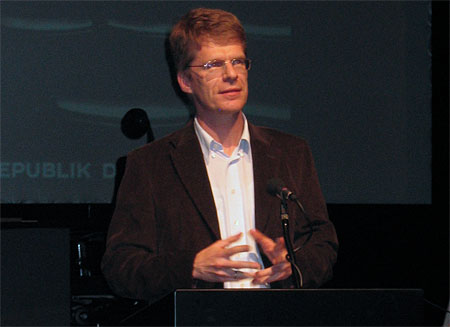
What does artificial music composition have to do with chess? Let me tell you about Ludwig. That is an AI music software suite developed by Matthias Wüllenweber, with whom I founded the chess software company ChessBase, back in 1987.
Matthias is the programming brains behind our products. He is also a music aficionado. At some stage he discovered that the search algorithms he was using for chess are also applicable to the composition and arrangement of music. So he took a break and created Ludwig.
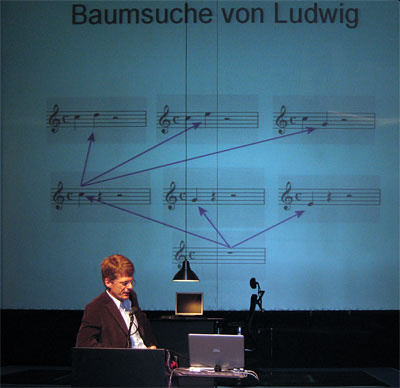
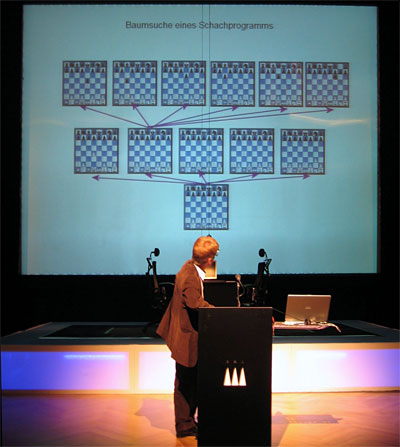
Matthias explaining how Ludwig mimics a chess search.
Let chess grandmaster Danny King explain how Ludwig works.
And here is Ludwig arranging Bach’s “O Haupt voll Blut und Wunden” as a classical four-part arrangement, applying around 50 rules of music theory and writing an independent and pleasing bass line in the process.
The demonstration is in German, but it is easy to follow the gist.
So Ludwig is a program that helps you to write your own songs, making them highly presentable. You simply enter or play a melody—the computer does the rest: it finds the proper chords and writes all parts of a professionally sounding band or orchestra. It has never been easier to compose, arrange or accompany songs. You can choose from a broad variety of styles — apart from classical it allows you to select Pop, Pop Ballad, Rock, Rock Ballad, Big Ballad, Funk, Disco, House, Jazz Combo, Fast Swing, Samba, Salsa, Rumba, Beguine, Tango, Klezmer, Folk, Polka, March, and many others. You can even define your own styles. And if you don’t want to or can’t enter your own melodies just load them from a database of many hundreds of public domain songs that are included in the package.
You can download and try Ludwig 3.0 here.