"What's in a name? The poet is Wilde, but his poetry's tame."
– – Punch, 25th June, 1881 *
A reader once wrote: Can you do a better job explaining the name of World Champion Vishy Anand? I'm confused by the father-to-son and husband-wife naming conventions in his family." – Pete, a fan of either Vishy or Anand." Okay, here goes:
He was named "Anand" at birth, and as a good South Indian Brahmin the name of his father was tagged on, to distinguish him from the hundreds of thousands of other Anands that walk the land. The system is simple: you get a name, one name, and add it to your father's name. This is similar to the Icelandic tradition, except the "son" part (as in Gustavson, Perutursson, etc.) is left out.
Now Anand's father is Viswanathan, an affable Railway executive who loves golf. So it became Viswanathan Anand, which translates roughly to Viswanathan's son Anand. The spelling is correct, the 's' is usually pronounced "Vish..", which is why the name is sometimes misspelled Vishwanathan. The stress (if any) is on the first syllable: VISH-wah-nah-thaan – with all the 'a's as in the English 'bath'.
Quick IQ quiz: Anand's father is Krishnamurthy Viswanathan. What is Anand's grandfather's name?
Now the correct way to address Anand is as follows:
- If you are a stranger and want to show respect call him Mr Anand;
- If you are a friend or in informal circumstances (in a gym or at a chess tournament) call him Anand;
- Never call him Mr Viswanathan. That would be simply silly – an unexpected mention of his father.
When Anand first came to visit and stay we all called him Anand (what else). He was 17 at the time. Some years later, during an event in Las Palmas, I first heard someone refer to him as "Vishy". I thought this was quite rude and asked Anand about it. "No, I'm cool with that", he said. So Vishy it became, and over the years people started calling him Vishy Anand.
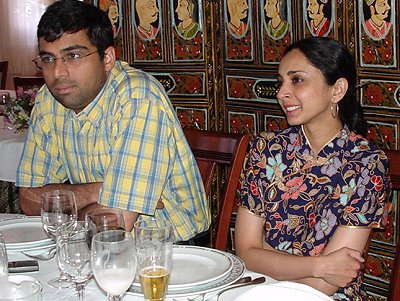
When Anand got married his wife Aruna became Aruna Anand. I don't know why in the case of women it appears to be that way around, but I have also heard Anand being referred to as Anand Viswanathan, so maybe it is interchangable. The polite form of address is Mrs Anand, if you know her well you can call her Aruna. (Interestingly her father's name is Ananth, so before her marriage she was Aruna Ananth – talk about minimizing the change!). When they are together Aruna calls him Anand, as in "Aaanand, tell him to stop teasing me!" When she talks about him to other people she may call him Vishy, because she knows they will otherwise be confused. A common friend, Almira Skripchenko, once expressed surprise when she called him Anand. "Why is she calling him by his surname?"
Patronymics in Russia
My first raw encounter with the Russian system of names was in the early eighties when I was visiting Moscow with Ken Thompson, the computer chess pionieer scientist who also invented Unix. We were put into different hotels. Since I could not locate him I decided to call our host, ex world champion Mikhail Botvinnik. I tried, but someone spoke to me in Russian.
So I asked my Intourist guide to call for me. "You want me to make phone call with great champion Botvinnik?" he asked in disbelief. When I convinced him it was okay, we were friends, he said he would do it. But needed to know Botvinnik's otchestvo. His what? "What is his father name?" he repeated in clarification. "I don't know," I said impatiently, "just call him please."
But my Intourist guide was adamant. He actually went down the street to a bookstore and came back triumphantly with the information he needed to be able to call Botvinnik: Moiseevich, son of Moise (Moses). Without that he simply couldn't call, it would have been too rude to call him Mr Botvinnik.
This is how the system works. In Russia your full name comprises a first name (imia); a patronymic (otchestvo); and surname (familiya). A person’s otchestvo is really important to know:
- If you are from the West and you don't know him well, call him Mr Kasparov;
- If you are Russian and in a formal situation you'd better know that his father was Kim, so you call him Garry Kimovitch;
- If you are from the West and want to impress him, call him Garry Kimovitch.
I use Kimovitch in mock reproach ("You've got to get your act together, Garry Kimovitch!") or if I am really, really impressed by something he has done.
Russians of course know how to build patronymics, which simply mean "son (daughter) of" and are formed by adding a suffix to the father's name: -ovich/evich for a boy, -ovna/evna for a girl.
Russian surnames
You may have noticed that a lot of Russian surnames end in –ov/-ev, or –iy/oy Kaspar-ov, Kamsk-y. The more observant amongst them have also noticed that women’s’ surnames end differently; -ova/-eva, or –aya.
When a surname ends in ov/ev it is simply treated like a masculin noun. Feminine nouns end, broadly speaking, in a or ya. Surnames that end in iy/oy have adjectival endings (Dostoyevskiy, Tolstoy). Yes, they are nouns, but the way they change according to gender and case is just like an adjective. The wife of Dostoyevsk-iy would be Dostoyevsk-aya. The daughter of Tolst-oy would be Tolst-aya.
As for the origin of typical Russian surnames; the -ov/-ev is (confusingly) the ending given to nouns in the genitive plural. Originally these surnames meant 'of the family', 'of the region' etc. It's similar to 'van der' or 'von' in Dutch or German. The adjectival ending surnames were probably formed along the same lines: to describe places/professions/characteristics of ancestors in the mists of time.
It should be remembered that there are other endings for surnames in Russia. Putin, Lenin, Pushkin for instance. Surnames can be different for all sorts of reasons. They can be of foreign in origin, Jewish surnames, Muslim, etc. But usually (if anything can be described as usual in the Russian language), these will be adapted to show the gender of their possessor.
Patronymics in general
-
Icelanders, as mentioned above, are named after their fathers. Magnus Ragnarsson's father's first name would be Ragnar. If Ragnar also had a daughter, her last name would be Ragnarsdottir. Ragnar himself would be named after his father, something like Ragnar Gunnarsson. So people tend to identify each other by first name, and even entries in telephone directories are typically sorted by first names rather than last names.
-
Patronyms are also used in Greece, and can tell you from which region a person comes: Peloponese "poulos", e.g. Petropoulos (son of Petros); Crete "akis", e.g. Petrakis (son of Petros); Macedonia "ides", e.g. Petrides (son of Petros); Island of Cephalonia "atos", e.g. Petratos (son of Petros); Mani region os Peloponese "akos", e.g. Petrakos (son of Petros); Asia Minor "oglou", e.g. Petroglou (son of Petros). The last is also used by the Turks.
-
In Spanish culture – at least in Cuba and Puerto Rico – you add your mother’s maiden name to the end of your name. That is the name that is used to look someone up in the phone book. Jorge Menendez becomes Jorge Menendez Donnell, and to find him in the Puerto Rican phone book, one must look under Donnell. Narciso Rabell, who is the FIDE delegate from Puerto Rico, is Narciso Rabell Mendez. However, when you speak with them, you would address the twwo as Jorge Menendez and Narciso Rabell.
-
The Iranian -zadeh means son of, as in Moshrefzadeh.
-
In the Arab world, fathers will sometimes proudly attach the names of their sons. "Abu" means father of, and Umm means mother of (Ibn means son of, and Bint means daughter of). Abu Bakr and Abu Hamid mean father of a son named Bakr or Hamid. This should help you understand why in news reports you will often hear a Palestinian negotiator referred to by name, followed by the additional information, e.g. the new Palestinian Prime Minister, Mahmoud Abbas – commonly known as Abu Mazen...
-
The Welsh ap or p is a patronym builder. Pritchard comes from ap Richard, son of Richard, and the common Welsh name Pugh is derived from ap Hugh.
- In English we have Johnson, Jackson, Peterson, etc. Fitz- also denotes "son of" (as in Fitzgerald, son of Gerald). But this prefix was frequently used for illegitimate children of aristocrats (e.g. Fitzclarence = son of the Duke of Clarence) and royalty (Fitzroy = son of the king). So Henry Fitzroy, Duke of Grafton, was the bastard son of Charles II and Barbara Villiers, the Duchess of Cleveland. Fitz is the Norman form of the modern French fils = son.
Hungary
Here the order of names is inverted. He writes his name as Lékó Péter. Hungarians who want to be friendly call me "Friedel", assuming that is my first name.
Chinese names
When I first met the Chinese prodigy Hou Yifan, she had just turned thirteen. She didn't speak English, but somebody pointed out her trainer to me. I approached him and asked if he was looking after Hou Yifan. “No?! Never heard the name,” he said. I pointed to her and said, “I was told you were that girl'sd trainer.” His answer: "Ho Eefan! Yes, of course!"
The problem was that I had not sung the name correctly! Chinese is a tonal language, which uses pitch to distinguish meaning. The word "ma" can have four different meanings – mother, hemp, horse and scold – depending on the tone you use. Hou Yifan, written 侯逸凡 in Chinese, is pronounced "Ho-ee? Fan!". The first two syllable are spoken with a rising tone, as in a question, while the third syllable has a declining tone. In any case my “Ho Yee Fan”, spoken in a flat pitch, was quite unrecognizable to her trainer.
Yifan, which is pronounced "EEfan", is the equivalent of our first names. So friends and family address her as Yifan, while in formal situations she is Ms Hou Yifan. We asked grandmaster Ding Liren about his name, and he answered: "My first name is Liren and my family name is Ding. Everyone in China calls me Ding Liren. Usually people call me with my full name or the first name." The safest is to call Chinese players who have three-syllable names with both names ("Hey, Ding Liren, shall we go for dinner?" is better than "Hey, Ding, ...). I believe it is quite necessary for two syllable players: "Wang Hao, did you win?" – never "Hao, did you win?"
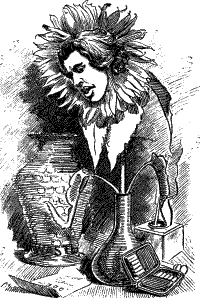 * Footnote on our quotation above
What's in a name? In 1881 Punch magazine propagated the following jingle, printed as a caption to a caricature of Oscar Wilde within a giant sunflower, the symbol of the Aesthetic Movement:
Aesthete of Aesthete's,
What's in a name?
The poet is WILDE,
But his poetry's tame”.