Looking for a hobby? How about composing some chess problems? I would like to entreat you: try it – you cannot imagine how satisfying solving and composing chess problems is. Especially the special kind known as helpmates.
Chess is all about mate. You must admit that the ultimate goal of the game should receive its share of attention. The only problem is that mates never actually occur. Virtually never. Sometimes at an open or in a blitz game a player will actually deliver mate; many have done so in their early pre-teen tournaments. But even when they mate it is usually a very mundane affair, with a protected queen slamming itself onto a square next to the enemy king, or one of those perennial back rank affairs.
All this is a real shame because the game of chess contains a vast treasure-trove of extraordinarily beautiful mating motifs. There are thousands and thousands of checkmate positions which normal human beings playing in regular chess tournaments will never see. Ever.
One reaction to this unfortunate situation was the chess problem, which appeared almost together with the advent of chess. Here an artificial situation is constructed where one side can deliver a very difficult (actually hard-to-see) mate in a specific number of moves. "Mate problems" have been around since the invention of chess. They can probably show us an additional few percent of the checkmates that exist with the 32 pieces of a chess set.
Then, in 1860, the great composer of chess problems, Samuel Loyd, had an idea. He describes it in the book shown here, which remains one of my great problem chess treasures. It is a Dover book from 1962, originally published by Whitehead and Miller in 1913. It was given to me by a friend from Finland, Mika Korhonen, back in 1987, when he saw how attached I had grown to it during a stay in his apartment in Helsinki.
Problem number 25 in the book introduces the concept of a "help-mate". In his annotation Loyd is quoted as saying: "The most suggestive field for a new school of problems that has ever occurred to me, and one which would open up a new line of wonderfully intricate combinations, is shown in number 25, where the query is merely: How could it possibly happen that White effected a mate in three moves? This it will be observed necessitates an active participation on the part of the Black forces, for both parties enter into a friendly alliance to effect the mate."
It was the first full-fledged genuine helpmate ever published, and it introduced a new era into chess problem composition, which has resulted in tens of thousands of exceptionally beautiful and fascinating problems. After the direct mate, the helpmate is the second most popular type of chess problem.
"Black to play, and White to mate (with Black's assistance) in three moves" wrote Loyd below the diagram.The solution is given below, but before you peek, you may want to try to find it yourself. For newbies: Black plays the first move, both sides work together and cooperate to construct a position in which the black king is mated. They have three moves (by each side) to do this. Move the pieces on the diagram to construct the mate. You will find it harder than you expect.
The above problem was originally published with a black bishop on h2. This is superfluous and was the remnant of earlier attempts some months before to construct the problem with a different checkmate position. In fact the earliest version had two black bishops on g2 and h2, and Loyd had written a story around the problem entitled "The Sin of the Nuns" (i.e. the two black bishops). But after discovering a much nicer solution the "cook" became the main problem.
So let us solve this historical first helpmate ever composed. It would seem quite impossible to find a way in which the rook and bishop can mate, even with the cooperation of Black. Remember all the moves must be legal. The main problem is the black queen, which is such a powerful defensive piece. In fact the solution requires a double-check in which the queen cannot cover both lines of attack.
So Black starts with 1.Kf6 (in helpmates the black move is written like white moves in normal chess) 2.Ra8! Kg7 3.Bb8! (allowing the black king access to the corner square) Kh8 4.Be5#.
In Helsinki Mika showed me one of his own compositions, which occupied me for quite some time (he forced me!). Here it is:
I want you to try and solve this elegantly simple helpmate. I bet you won't succeed! Note that helpmates can have multiple solutions. The only condition is that they must result in different and distinctive final mates. And in both solutions the order of moves must be unique. In no case can either side deviate from the one and only path to mate.
When I found the solution to Mika's problem I became enamoured with helpmates. I solved countless problems in this category, and was egged on by John Nunn, who is also a virtuoso helpmate composer. At some stage, I decided to try composing a helpmate myself. I will describe the process here.
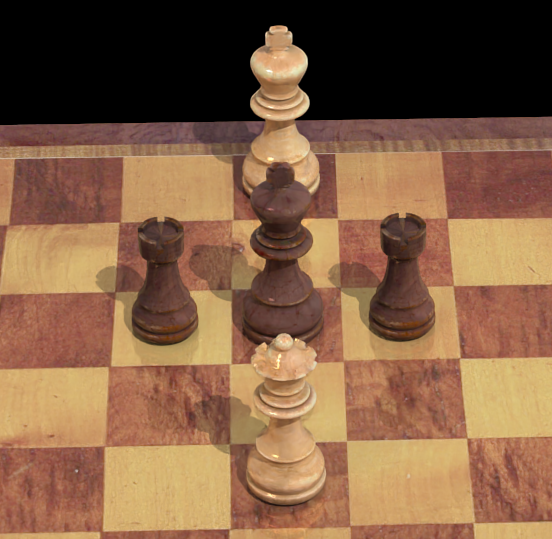 The idea I had was to find a helpmate that resulted in the pretty mating position shown in the picture. It is a variation of the well-known "epaulette mate".
My first attempt was the following starting position, an unusual mating position that occurred to me.
| |
You can play through the intended solution by entering the moves on the above diagram: 1.Rc5 h5 2.Re6 h6 3.Rcc6 h7 4.Kc5 h8=Q 5.Kd6 Qd4#. Bingo, we have my envisioned mate! I was really pleased and contemplated submitting the problem for publication. But you have to look at the position carefully before you do this. Chess engines were of no use in checking, so I had to do this manually, using Brain 2.0 (which I have installed in my head) to look for cooks. It took some hours, but this is what I found:
If you play through the alternate lines you will see how they spoil the composition. Helpmate problems are very strict about purity: there must be no deviations – a single unique line of play must solve the problem.
So I got back to work looking for a sound version. I don't recall how long it took, but I finally came up with the following position:
The solution: 1.Rc5 h5 2.Re6 h6 3.Kc6 h7 4.Kd6 h8=Q 5.Rc6 Qd4#. This helpmate is valid and valuable because:
- it produces a pleasing and unusual mating position; and
- there is only one unique set of moves that fulfils the condition, leading to mate in the required number of moves.
Not a single deviation is possible, no change in move order, no transposition. That is what is required of a proper helpmate. You can enter moves on the above diagram and try to find alternatives ("cooks"). I am sure you will not be successful.
So why don't you try doing this yourself? (I speak here to amateurs, not to professional problem composers who churn these things out before breakfast). Look for an attractive mate, one you will never encounter in regular games. Then look for a position where a series of unlikely and hard to find move will lead to the mate – and then make sure there are no alternate lines to spoil the problem. You cannot imagine how satisfying it is to come up with a sound helpmate.
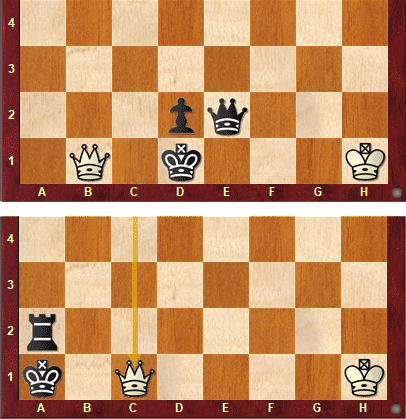 Solution to Mika's helpmate.
- First solution: 1.Kb1 b4 2.Kc1 b5 3.Kd1 b6 4.c1Q b7 5.Qc4 b8Q 6.Qe2 Qb1 mate.
- Second solution: 1.d1B b4 2.c1R b5 3.Rc2 b6 4.Bg4 b7 5.Bc8! bxc8Q 6.Ra2 Qc1 mate.
Did you solve it? Here are the two final mates. Amazingly, it is only possible to construct them from the very simple initial position with two unique series of moves.