In 1983, in the first issue of the German magazine “Computerschach International”, I published this little problem:
The problem is not difficult, but our readers were asked to solve it in their minds. Perhaps you will try that as well – make a note of the time it takes you to work out the white win. Also, think, at least briefly, about why other moves do not work.
You can also move the pieces in the diagram above and try to win. The built-in engine will defend.
Solution: 1.bxa6? doesn’t work: 1...b5 2.h4 b4 3.h5 b3 4.h6 b2 5.h7 b1=Q 6. h8=Q Qb8+ and Black wins! 1.h4? is also a mistake: 1...axb5 2.h5 b4 3.h6 b3 4.h7 b2 5. h8=Q b1=Q is a draw. The win is 1.b6+! and now 1...Kxb6 2.h4 a5 3.h5 a4 4.h6 a3 5.h7 a2 6.h8=Q wins.
There is a second important part to the problem, and it is a bigger challenge. In the above position move the white king from c8 to d8, and now find a win for White. Why does it make a big difference, why does the position become substantially harder?
The most telling reaction to the problem was by Garry Kasparov. We were at dinner with potential chess sponsors, and I was boasting about his skills. At one stage I said to them: “He can solve things in his mind, like no other chess player in the world. Let me demonstrate.” And I dictated the above position to Garry, leaned back, and waited for his solution. But it did not come. “The position is wrong,” he said to me. Embarrassed, I dictated it again, more carefully. But he still wouldn’t react. He just frowned.
What was the problem? The position was too simple! It was like I was boasting about the world class mathematical skills of a person, and then, seeking to demonstrate, asked him “What is two plus two.” I told Garry to just tell it to us the solution to the above position, and then said: “Part two: we move the king to d8.” Garry looked perplexed: “But what is the difference… Wait, ahh, a stalemate defence!” He thought about it for a little over two minutes and then said: “Very nice, Fred!” and dictated the solution flawlessly.
Once again I want you to try to find the win for White in your mind, without moving the pieces. Make a note of the time it took you if you succeeded. Try to solve it without looking at the solution below. If you cannot do it in your mind, move the pieces on the board above. The engine will defend for Black.
I have given the problem pair to many budding young chess players. A typical example: in 2015 we had some guests in the ChessBase office in Hamburg: Heike and Christof Keymer, both musicians, their daughter Cecilia – and ten-year-old son Vincent. He was rumoured to be a great chess talent.
So I put him to the test. I dictated the first position to the lad, which he solved in one minute. Then I gave him the twin, telling him to move the white king to d8. There was no chess board or pieces in sight. I got a similar reaction to Kasparov: “Why is that… oh, wait, I see the complication!”
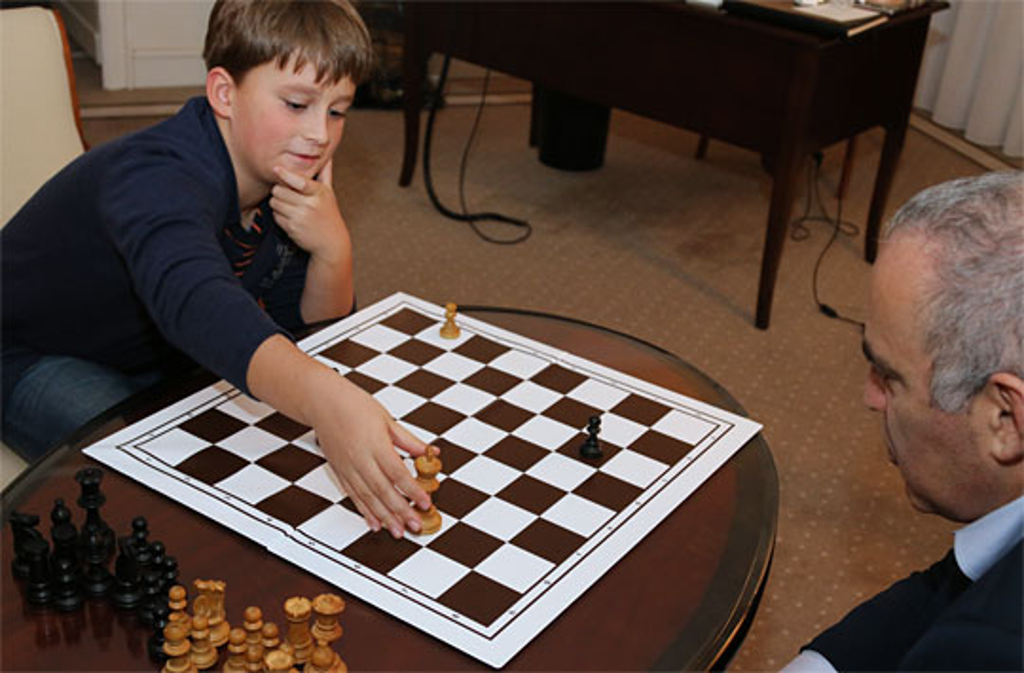
We went on to take lunch, and the lad behaved quite normally, eating and conversing with us. Suddenly, in the middle of the meal, I said: “There, he’s got it!” Why did I say that, everyone wanted to know? “Just look at his face,” I said. Vincent was glowing with pleasure. “Get a board,” somebody said. “No need,” I said.
And Vincent dictated the solution rapidly to us. “This boy is going to the very top,” I thought. And right I was: today, at seventeen, Vincent is 2700 Elo strong, a grandmaster and one of Germany’s leading chess hopefuls.
One further example (of many): in 2019 I visited a tournament in Mumbai, India. There I got to know two very interesting young players: Savitha Shri, eleven years old, who two months earlier had won the World U12 Girls Championship; and Gukesh Dommaraju, twelve, who already had two grandmaster norms under his belt. I gave them the twin problems,
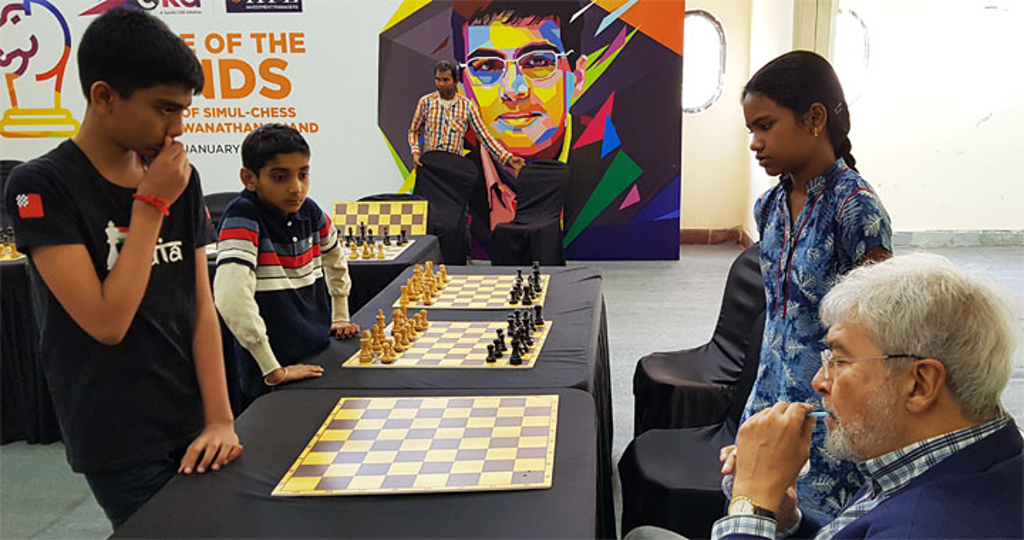
Savita struggled, and spent 25 minutes thinking. Nothing could distract her. Gukesh took four minutes to come up with the solution to the second part, all in his mind. With that I knew: this lad is an exceptional talent and was headed for the top. A week later he had completed his final GM norm and become the second-youngest grandmaster in chess history. Today Gukesh, who is now 16, is the is number 18 in the world, with Elo 2732 on the FIDE world rating list. As I write these lines, he has just won a game against Magnus Carlsen. That makes him the youngest player in history to beat a reigning World Champion.
At the event in Mumbai I was introduced to half a dozen young talents of similar calibre (I think they grow them in paddy fields in India). They all got my talent test dictated to them. But I am afraid that is the end of it. Later that day I saw a number of players puzzling over the position on chessboards — the super-talents had rushed off to show the puzzle to their friends. So in the future when I meet a budding young player and say: "I want to test your talent with a puzzle..." they will answer: "You mean the 1.b6+ position?" Well, it served me nicely for almost forty years, with hardly any top player who has not been confronted with it.