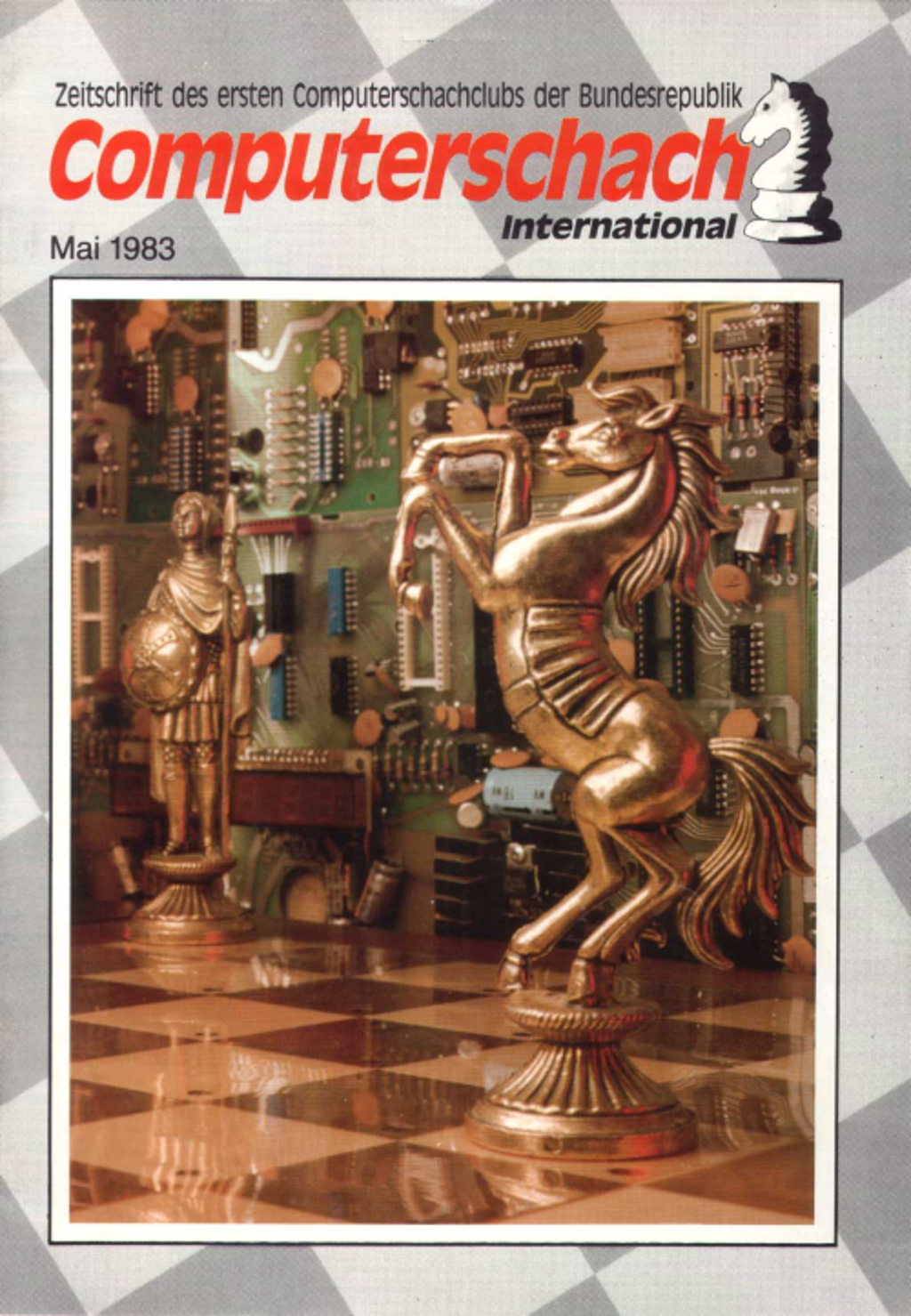
 The following studies have been my favourite for almost forty years now. I first described them in the German magazine "Computerschach International", which I edited together with a colleague. It appeared six times a year, and was produced in pioneering fashion: we typed out the text on an electrical daisy-wheel typewriter that could do boldface. In fact we had programmed it to do right justification, initially by inserting blanks between the words, then with micro-spacing.
Let us begin with the following volatile position from edition 2 of the magazine:
The very plausible move, 1.Rxa8, doesn't work: 1...Nxa8 2.Kxa7 and now almost any move, 2...Kxc6, 2...Nc7, 2...Kc7, or even 2...Kd5 will result in a draw. You can click on the fan icon to start a chess engine to confirm the above. You can also use it to see that 1.axb6 Rxb8 and 2.Kxa7 or 2.bxa7 is hopeless as well. So how can White win? The engine will immediately show you the anti-intuitive strategy that White must employ – and the point of the surprising manoeuvre. And show you why nothing else works.
The second study can be solved by trial and error:
In this tactical study you can move the white pieces on the diagram to try different ideas. But there is no attached engine to help you find the correct moves. Full solutions to all the studies are given on a replay board at the end of this chapter.
It is clear that White must eliminate both black pawns while keeping the two minor pieces. 1.Nxd7 clearly doesn't work: after 1...Kxc8 White can no longer win with the lone knight. And all other knight moves (or king moves) in the above position simply lose the bishop. This quickly leads to an important conclusion: White must start with a bishop move. One looks especially tempting: 1.Bxd7. But Black simply replies with 1...Kc7, making sure he can win one of the white pieces for a forced draw.
After 1.Bb7 we have the same problem: 1...Kc7 wins one of the white pieces. So it seems to be clear: White must start with the only bishop move that is left: 1.Ba6. After 1...Kc7 and we see that the knight has no escape square and will be lost on the next move. So what to do?
You may be forgiven for thinking that the diagram is somehow wrong, and White cannot win. It is especially annoying if you have spent some time working on the position, and the author says "oh sorry, there's a white pawn mission on b5". But the diagram is correct. If you fool around with the pieces, you have a good chance of discovering the "Troitzky Mate" that decides the game. Solution at the end of the chapter.
Now for one of my all-time favourite studies:
This study is subtler than the previous two. Once again, we want you to try and find a win without computer help, just by moving pieces on the diagram.
Let us study the position together. Black can clearly convert the a-pawn, since the a1-h8 diagonal is effectively blocked by the black d-pawn. It looks like the position is lost for White. But we are saying he should somehow win?! After 1.Bf6 Black simple plays 1...a2, and White cannot stop the a-pawn from promoting. If we try 2.c3 Black doesn't take the pawn (2...dxc3? 3.Bxd3+–), but promotes with check. 2.c4+ doesn't work either: 2...Kxc4 3.d3+ Kxd3 and the black d-pawn still covers the a1 promotion square. Playing 1.c4+ immediately doesn't change anything – Black wins in the same way.
So what about knight moves? We can try 1.Nd7 a2 2.Nb6+, but after 2...Kc6 White cannot stop the a-pawn. 1.Nc6 looks interesting, since it threatens a fork on b4. But 1...Kxc6 2.Bf6 Kd5 once again protects the a-pawns queening square. It really looks like there is no way to stop the a-pawn, and Black is in fact going to triumph. Chapeau, if you can find the very clever way White can actually win. Please take some time before you look for the solution in the replay board at the end of this chapter.
Finally, I would like to give you a remarkable study to solve all by yourself.
Here it seems clear that Black should be able to draw quite easily, since White will have to sacrifice his rook to stop the h-pawn. But there is a very subtle way for him to win, starting with a truly unexpected move and a very clever way to finish. Please try to find it and win the above position. The solution is given on the replay board below.
Here are all four studies in a replay window:
Clever twins by Kovác
We close with two simple but very clever studies for you to solve on your own. The diagram engine will try to win for Black, but will of course not succeed if you find the right strategy. I will not give you any answers.
Have fun working this out.