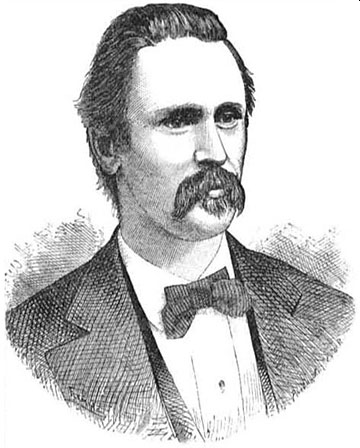
 Samuel Loyd (1841 – 1911), was an American chess player, chess composer, puzzle author, and recreational mathematician. At his peak he was one of the best players in the country – and number 15 in the world. His chess problems were numerous and famous for their original and often humorous themes.
A dangerous game
In the year 1713 the Swedish King Karl XII was waging war against the Turks. A man of great equanimity, he liked to enjoy a quiet game of chess, even while his soldiers fought outside his tent. During the Battle of Bender he was playing a game against his general and with White he reached the following position:
"Mate in three moves!" said the king. [You can try try to find it by moving the white pieces on the diagram, which will try to defend]. But before he was actually able to execute a move a bullet flew into the tent and smashed the knight on e1.
The general froze, but King Karl continued to calmly study the position. "Well", he said, "then mate in four moves!" But once again he wasn't able to make a move, because a second bullet entered the tent and shattered the pawn on h2.
The king remained unperturbed, and after a few seconds announced mate in five moves.
These three parts of a wonderful little problem were composed by Samuel Loyd. It is interesting that the editor of the magazine "Chess Monthly", where the puzzle appeared in 1859, thought up the story, and he asked Loyd to compose a chess position to suit it. Loyd did so in less than a day.
In 1900, a fourth part was added by the Baltic German composer Friedrich Amelung, who continued the problem narrative: The general, his nerves completely frayed, watched his monarch execute the mate without the two destroyed pieces. With a wry smile he said, "What a pity, your majesty, that the first bullet didn't remove your rook instead of the knight."
"Then", answered the King, "I would simply have delivered mate in six!"
In 2003 Brian Stewart drew my attention to the fact that if the second bullet had struck the g-pawn instead of the h-pawn then the king would still have been able to win.
In that case the king would have a mate in ten. Try to execute it against the defence of the diagram.
Prequel by Pal Benkö
One of the great composers of our time, Hungarian GM Pal Benkö, told me that the two additions to the original Loyd puzzle were not so valuable, since they didn't fit and were full of duals. "May I send you mine?" he asked. Sure thing:
In this position, Pal told me, the king had just announced mate in two. That was when the first bullet struck and shattered the rook on g4. After that we have the first position of Loyd's series. "It fits, with mates in two, three, four and five," wrote Pal. Indeed it does – the great 19th century composer missed this chance!
Here are all the above problems with the solutions for you to play through: