In this chapter, we will be looking at the following endgame:
Can Black win in this position? In the above diagram, with Black moving up the board, you can try. The diagram will play against you and defend for White. At the end of this chapter you will find a replay board with all the variations.
Here's the position again, this time with an engine button that will help you follow the analysis.
The Chess Informant said Black could indeed win the above position. And in the game Kalinichenko did so with the lovely move 1...Bh1!! (note that after 1...Bf3? 2.Bxf3 Kxf3 3.a7 or 2...g2 3.a7 White can at least draw) 2.b5 (2.Bxh1 g2 3.Bxg2 hxg2 4.a7 g1Q 5.a8Q Qa1+ also wins for Black) 2...g2 3.b6 g1Q 4.Bxh1 Qxh1 5.b7 Qb1 and 0-1, because the white pawns are effectively stopped.
When we speak of "tactical" combinations, we are usually referring to brilliant middlegame combinations, with sacrifices, skewers, forks, and mating attacks. Endgames are mostly "strategic", i.e. it is all about subtle plans that usually bear fruit only later in the game. The calm positional flow of an endgame, however, is not infrequently interrupted by an unexpected and dramatic combination shot. These are often overlooked by both players, since one is usually not watching out for tactical shots in the endgame.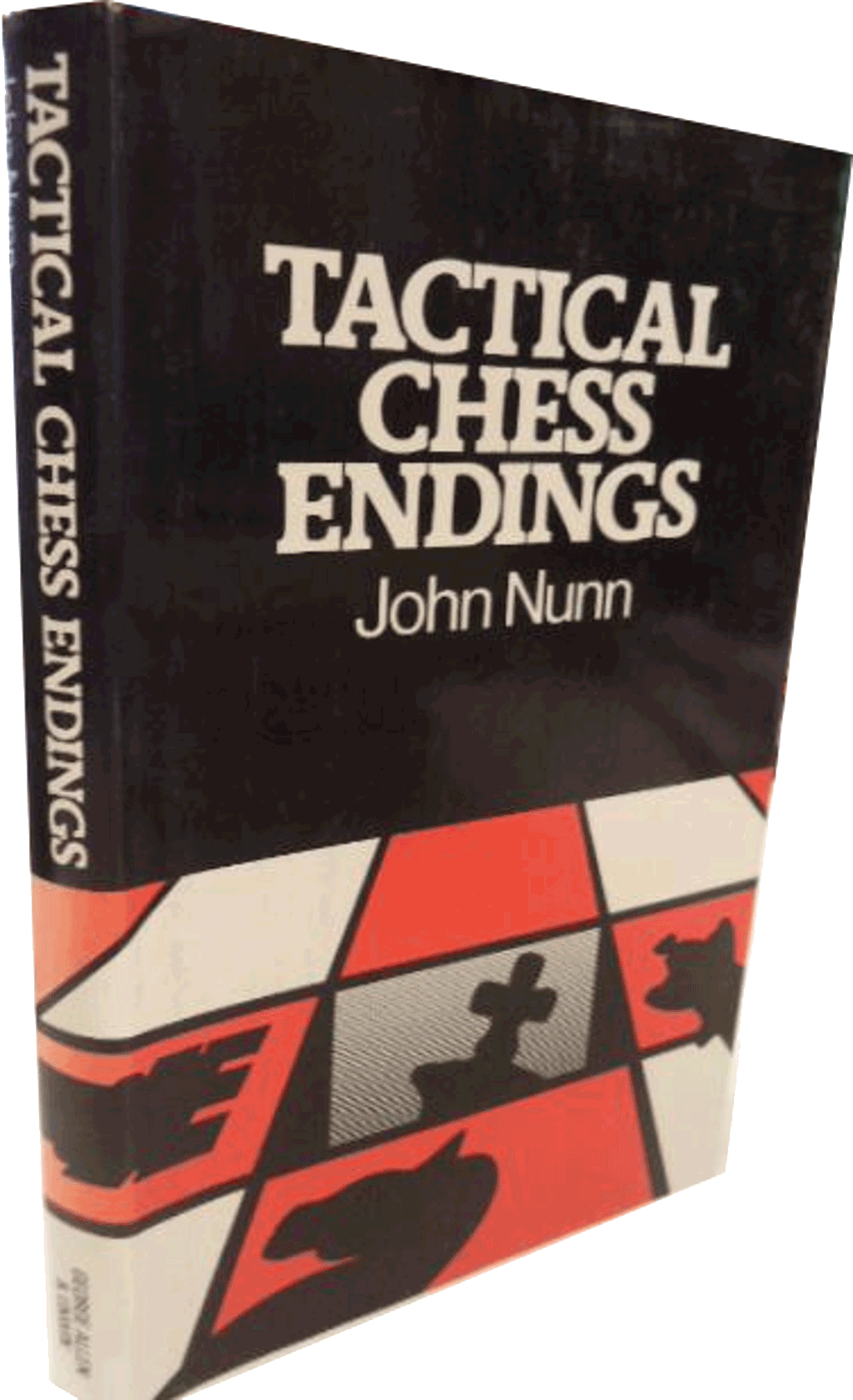 The above position was included in "Tactical Chess Endings," a book written by the English grandmaster Dr John Nunn in 1981. It is an unprecedented collection of interesting and instructive tactical endgame situations. Nunn, who spent some years at the Oriel College in Oxford, teaching mathematics (especially algebraic topology), had to often commute between London and Oxford. The one-hour journey, he told me, was perfect for the reliable analysis of a difficult tactical endgame. Many of the 134 endgames in his book were analysed in this way.
The book, which you can still get in a new edition, is especially valuable because, like nobody other, John Nunn refuses to copy uncritically from other publications. Most of the book contains his own analysis. Every outside source is quoted meticulously, and is usually followed by a discussion of the given assessment. The position above can serve as an example, and its clarification that took two train journeys.
First of all, it seemed to the British grandmaster GM, on the outward journey, that the text move did not lead to a forced win. After 1...Bh1 White should have played 2.Kb5!, since his problems are caused by the unfortunate position of his king on the a-file. In addition, he now threatens 3.Bxh1 g2 4.Bxg2 5.a7 draw. The opponent has no choice: 2...g2 3.a7 g1Q 4.a8Q Qf1+ (after 4...Qg5+ 5.Ka4 Black has no more checks) 5.Kb6! (not 5.Kc5? Qf2+, after which White loses, as a detailed analysis in the book clearly shows) 5...Qf2+ 6.Kc7 Bxb7 (The right moment! After 6...Qc2+ 7.Kb8 the white queen has more freedom ). 7.Qxb7 (after 7.Qf8+ Kg3 8.Qg7+ Kh2 Black wins) 7...Qd4! Now White might have some problems because his queen is badly placed, but one can hardly speak of a clear win for Black after 1...Bh1.
On the way back to Oxford, John found a clear win for Black. Based on the consideration that White needs two tempos in order to advance with his b-pawn and threaten anything, Black can calmly mobilize his king against the white pawns: 1...Ke5! Now White quickly loses:
- after 2.Bxg2? hxg2 3.a7 g1Q and 4... Qa1+;
- or after 2.Kb5? Bf1+ followed by 3...Bxa6;
- or after 2.Ka4 Kd6 3.b5 Kc7.
Hence:
A: 2.Kb6 Be4! 3.Kc7 (3.Bxe4 g2 or 3.Kb5 Bd3+ or 3.a7 Bxb7 4.Kxb7 h2 are hopeless) 3...g2 4.a7 g1Q 5.a8Q Qg7+ and after the exchange on b7 Black wins.
B: 2.b5 Kd6 3.Kb6 (3.b6 Bc6! and White can no longer promote: e.g. 4.Ba8 Bxa8 5.b7 Bxb7 6.axb7 Kc7; or 4.Bc8 h2 5.b7 Kc7) 3... Bd5 4.Bxd5 (4.a7 Bxb7 and h2) 4...g2 5.a7 g1Q+ 6.Kb7 Qg7+ 7.Ka6 (7.Kb6 Qd4+ and 8...Qxd5) 7...Dal+ 8.Kb7 Kxd5 and wins.
Forty years later, using endgame tablebases, John found that 1...Bh1! as played by Kalinichenko, does indeed win, albeit it with manoeuvres that are very difficult for humans to follow. In our replayer below you can check it all yourself. Switch on the engine (fan icon below the board) and let it answer your "why not..." and "what if..." questions.
Solving in Style
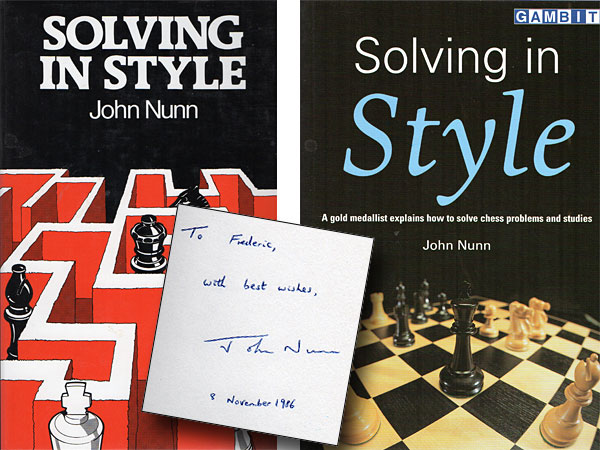 A second book was given to me by the author in 1986. I read it cover to cover, some of the sections multiple times, and still own the 1985 Allan & Unwin version. The book you can currently buy (from Gambit, Amazon, etc.) is an expanded edition and contains 50 per cent more material than the original. There are new chapters, and unsound problems from the first edition have been replaced. The book is available in a print edition, but also in the Kindle e-book format (from Amazon). You can also buy it in the Gambit Chess Studio App format via Apple or Google Play.
I still treasure my original print version, which our common friend Jon Speelman, who is a linguistically playful creature, called the Dissolving in Bile, a name that has stuck in my brain ever since. It has copious notes by me in pencil, and when I read these today, I am drastically reminded how far computers have come: "Impossible for computers" or "This is a line computers simply do not see" are comments that no longer apply. But the pure chess notes attest to the fact that I worked with the book intensively, and learned a great deal about problems and studies from it. There are chapters on studies, direct mate problems, helpmates, selfmates and reflexmates, retro, proof games, and more. I will be sure to write about some of them in due course.
The distinguishing feature of Solving in Style has always been John’s lucid explanations of the problems and how to go about solving them, something readers will probably be familiar with from his many contributions to ChessBase. The example below is one I picked by just randomly opening the book.
I love these very simple-looking positions that, you discover, are wonderfully subtle and complex. John tells us that after the Second World War composers found more and more difficulty composing such elegant lightweight studies, since most had already been discovered. "Happily, some composers have persevered with light positions and made discoveries overlooked by previous generations. Here David Gurgenidze improved on an idea originally shown by Mark Liburkin. It contains three different stalemate defences which White needs to overcome.
Play through all the lines with the engine switched on. And watch how it finds the correct white strategy on the path to victory.