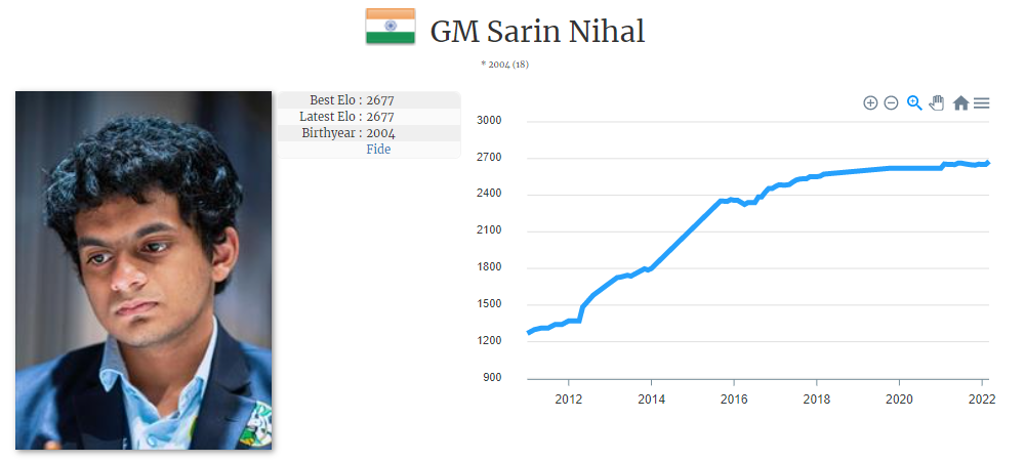
In October 2017 a remarkable young chess talent visited us in Hamburg. Nihal Sarin, from the southern Indian state of Kerala, deeply impressed all and sundry in the ChessBase office. The intention was for him to get instructions in the optimum use of our software, and a little bit of GM training on the side. It turned out that the question was who learned what from whom?
First of all: who is Nihal Sarin? He was born on 13 July 2004 Thrissur, Kerala (a southern state in India). He learned chess at the age of five from his grandfather because the boy was feeling bored at school and especially during vacations. He advanced rapidly and entered the record books by becoming an International Master (IM) at the tender age of 12 years and 8 months. His feat is reminiscent of the current world champion Magnus Carlsen of Norway, who had also become an IM at the age of 12 years and 8 months in 2003. Nihal was the second youngest International Master ever in India, and third youngest in the world. Less than a year after his visit, Nihal was a full grandmaster. He had just turned 14 when he made his final norm.
When Nihal first visited us in Hamburg, one of the first items on the agenda was lessons in finer points in the use of our software. Above you see Nihal receiving instructions from our chief training expert (and Playchess tournament director) Martin Fischer. On the right is Nihal's father Sarin, who by the way is a dermatologist teaching at medical school.
A word regarding names: as we explained in a previous article: at birth, South Indians get a single name (you may have heard of "Anand"), with the name of his father tagged on. So, it is simply Nihal, to friends and foe. As an adult he will be called Mr Nihal, but never Mr Sarin, because that is what you call his father. And chess annotations that say "Here Sarin found a brilliant sacrifice" are misplaced. Nihal played it, not his father.
Here's 12-year-old Nihal analysing with GM Dr Karsten Müller, one of the world's leading endgame experts. It was the start of a running gag at the time: when the session was over, I went in and said: "Well, what do you think? Is he talented?" Karsten turned towards me with the words "Yes, quite extraordinary, he will..." and then saw that I was not looking at him but at Nihal. "Quite right," he said, "I hope this boy will recognize that I have a certain potential for the game."
A personal assessment
I could only echo what some of the ChessBase experts said: Never seen anything like it before! Actually perhaps I had, in the 13-year-old Magnus Carlsen. But this lad was basically in a category of his own. His instant tactical vision, but also his deep understanding of positional aspects of the game, impressed everybody. And his size is an aggravating factor: Nihal was small for his age – the ladies in our finance department thought he was eight or nine. So to hear instant cutting-edge analysis spouting from him is even more surreal. Can you imagine what it is like for a bulky GM to sit across from him and fight unsuccessfully for survival? I told Nihal I suspected he is in reality a 23-year-old midget.
I did a number of experiments with Nihal. One was to show him some of my favourites studies. But that had little point. He would inevitably say: oh yes, I know that one. In one case he didn't, and paced my study frowning.
White to play. The question is: can he win this position?
This was a study that Garry Kasparov gave another young prodigy, Vincent Keymer, which he asked him to solve without moving any pieces. Not so easy – try to work things out in your head while staring at the above diagram. Vincent came up with the solution fairly quickly, but Garry was not satisfied with just the key move. "Great, but now find a defence for Black which makes things really difficult for White to win," he said. The study was tougher than anyone could imagine, and Vincent got a little help from Garry, who after the key defence was found explained some of the geometry involved. Here's the solution:
Nihal, on the other hand, dictated the entire solution, difficult defence and all, after four minutes of pacing.
Okay, so there was a suspicion that he was just remembering everything. But there is a great way to check that: I have the 85,000 studies database compiled by Harold van der Heijden on my computer. Well, I loaded a number of studies, at complete random, with the notation window of ChessBase switched off (so he could not see any moves). It rarely took him more than two minutes to come up with the correct solution, including all relevant lines of defence.
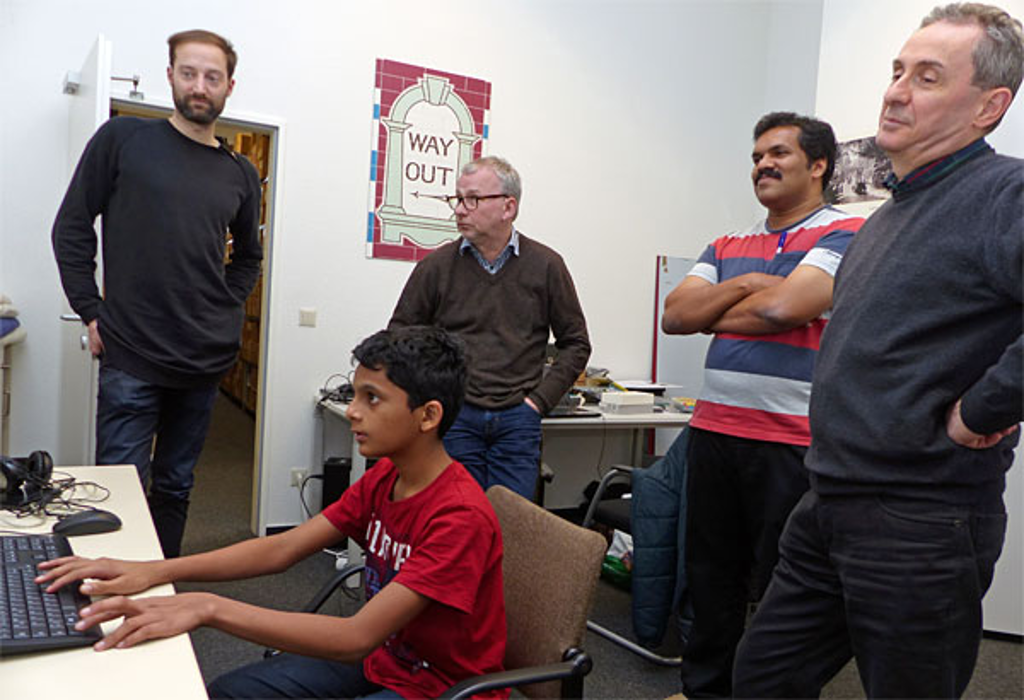
And the ChessBase staff did a corroborating test: they set the lad up with our Tactics Trainer, one that has over 50,000 puzzles. Nihal went through scores of difficult positions like a rhino through the grasslands (as one spectating GM put it).
I discovered at the time another strange ability that Nihal has: he can tell you the age of any top player from memory. I tested it, with obscure GMs, for example Vladimir Epishin. The answer came after a few seconds of thought. I asked him if it would not be more useful to fill the empty space in his brain with really useful information, but he assured me that there were still plenty of free sectors available for other stuff.
All of the above is pretty effusive, and already one of my most trusted friends, a 2800+ GM, after he got a verbal description, sighed and told me that I was going over the top, "once again". I reminded him that I had picked up Nigel, Judit, Anand, Sergey, Magnus, Yifan at very early ages – and he reminded me of a couple of prodigies whose names we have now forgotten. Anyway, the bet is that in five to ten years, I predicted, Nihal would be among the top ten players in the world. All he needed was proper training and full sponsorship.
Defining pawn promotion
In the ChessBase office it was not all work and no play. Nihal is highly entertaining, blessed with a keen sense of humour, and always open to pranks. I want to describe some of his escapades in part two of this portrait.
This is 15-year-old German chess talent Luis Engel, rated 2362, was doing an internship at ChessBase. "What is the rule for pawn promotion?" Nihal asked him. His answer: "When a pawn reaches the final rank of the board, it can be promoted to any piece the player chooses." After that Nihal gave them a chess problem;
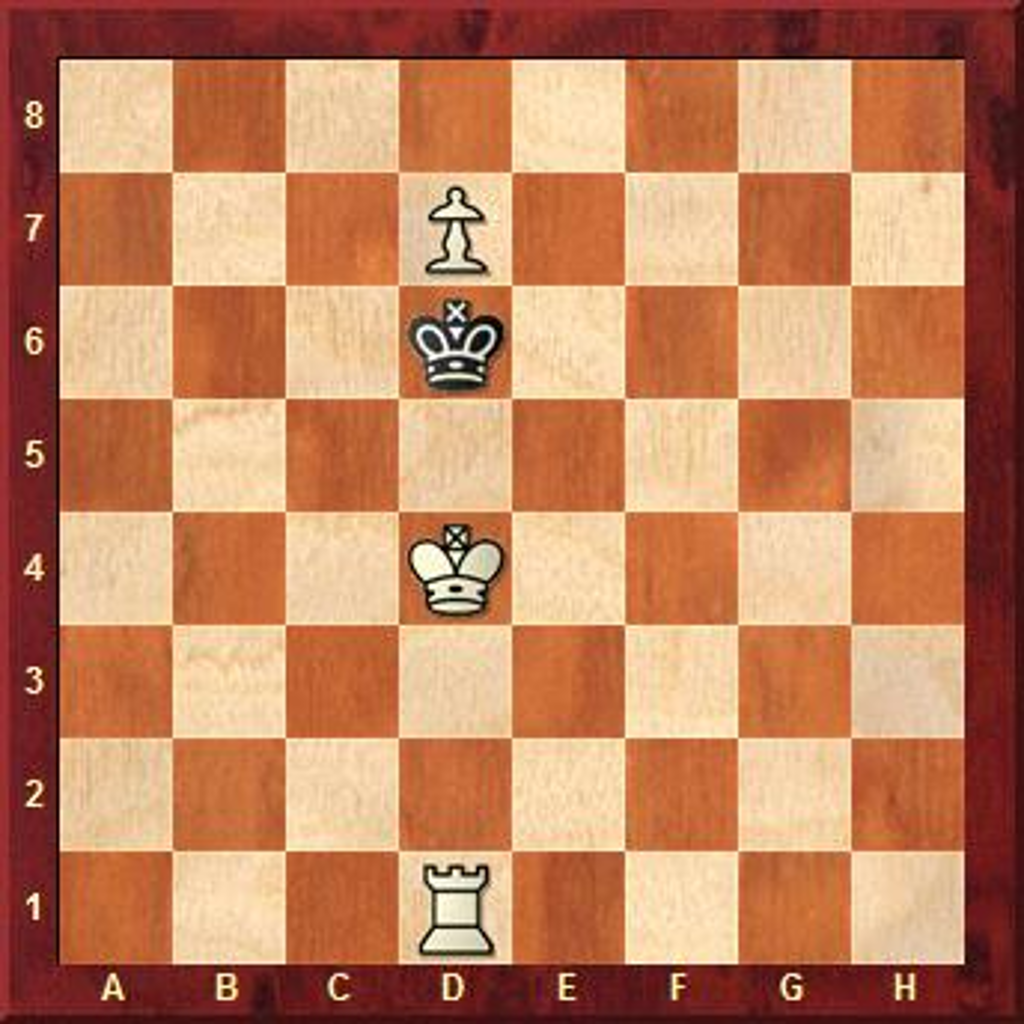
White to play and mate in three
Can you, dear reader, solve Nihal's problem? It looks impossible, but here's the solution: the only way for White to mate in three moves – is the devious move 1.d8K! White promotes the pawn to a second king and can now mate in two more moves: 1...Ke6 2.Rf1 Kd6 3.Rf6#. Ahh, so the rule was not correct! It should state: when a pawn reaches the final rank of the board, it can be promoted to any piece except for a king!
Okay, now you are ready for the next problem Nihal gave us:
White to play and mate in three
It looks fairly easy: bishop to b2 (or c3, d4, etc., to relieve the stalemate), black pawn queens, king to g3 and 3.Qh2 mate. That is wrong! Why? Because after the other bishop moves, Black plays the clever defence 1...a1P! The pawn is not promoted, and so 2.Kg3 doesn't work because it is still stalemate. The only correct solution is 1.Bf6! and now 1...a1P 2.Bh4 Kh2 3.Bxf2#.
Incidentally, Nihal's problems were composed by Dr A. Krämer and published in the magazine Deutsche Schachblätter in 1949. Unfortunately, we discovered a cook in the second position: White can also play 1.Kh3 on the first move and mate in three.
In any case the trick and lesson worked. The rule, we all agreed, should say: when a pawn reaches the final rank of the board it must be promoted to any piece, except for a king!
Next problem:
Once again White to play and mate in three
Above is Mathias Feist, chess engine programmer, chess trainer in his free time, a brilliant analytical mind. He went for 1.f8Q (followed by Kh7 and Qxh6 mate), but Nihal played 1...g2 and the line did not work. "Ahh, so 1.f8N!" said Mathias, "with Nh7 and Nf6 mate." No, because 1...Bf1 and 2...Rh2 allow the king to escape. So what to do? The Fritz programmer was at his wit's end.
Nihal's solution: 1.f8=?, i.e. you leave the pawn on f8. Mathias, who had been through the first two problems, said: "No, you have to promote the pawn, that was the rule we agreed on." Yes, but not necessarily on the same move! "Play your next move, and then I'll decide which piece to take," said the lad. If Black plays 1...Bf1 White changes the pawn into a queen, if Black plays 1...g2 he takes a knight.
So the correct rule is: when a pawn reaches the final rank you have to promote it, to any piece except for a king, on the same move! That led to Nihal's final problem:
Above is André Schulz, who runs our German language news page, being duped by the 12-year-old.
White to play and mate in two
André had also been taken through the three previous problems and had decided that the last definition was completely waterproof. But there is still a loophole, and he was stunned when Nihal showed him what we had missed. You, dear reader, should think about the problem for a while – the solution will suddenly occur to you, and make you smile. It is given at the end of this chapter.
Chess was not the only thing we fooled around with. One evening, I gave Nihal my famous guillotine problem (which I had published years ago on our news page). He was stumped and begged me to tell him the solution before he went to sleep. I did not, and the next day at breakfast I found that he had figured it out himself. Much more satisfying than getting it from Fred, isn't it? There were a number of other tricks and pranks while he stayed at my home, and also during an outing in the wild life park that is located just fifteen minutes away.
Nihal confessed that he had never encountered animals at such close quarters before.
Feeding bats in the special dark house. He thought I was the bravest person on the planet for doing this.
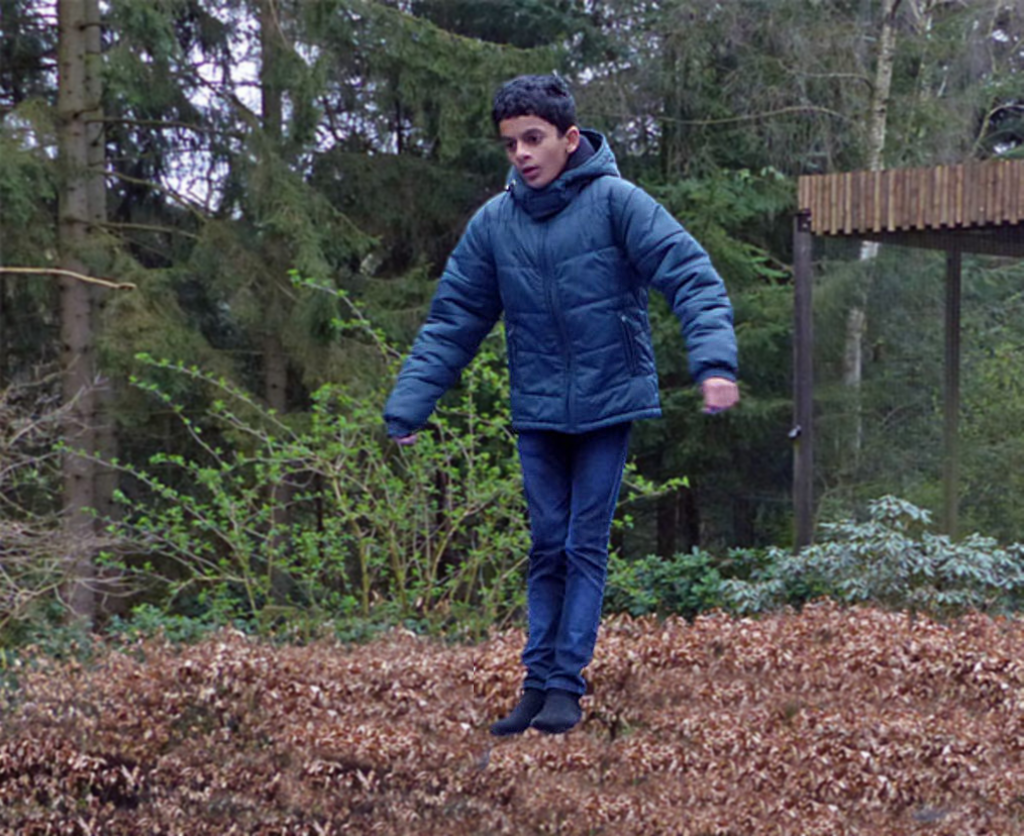
Nihal levitating?
Of course, it was all a trick, involving a trampoline and some judicious cropping
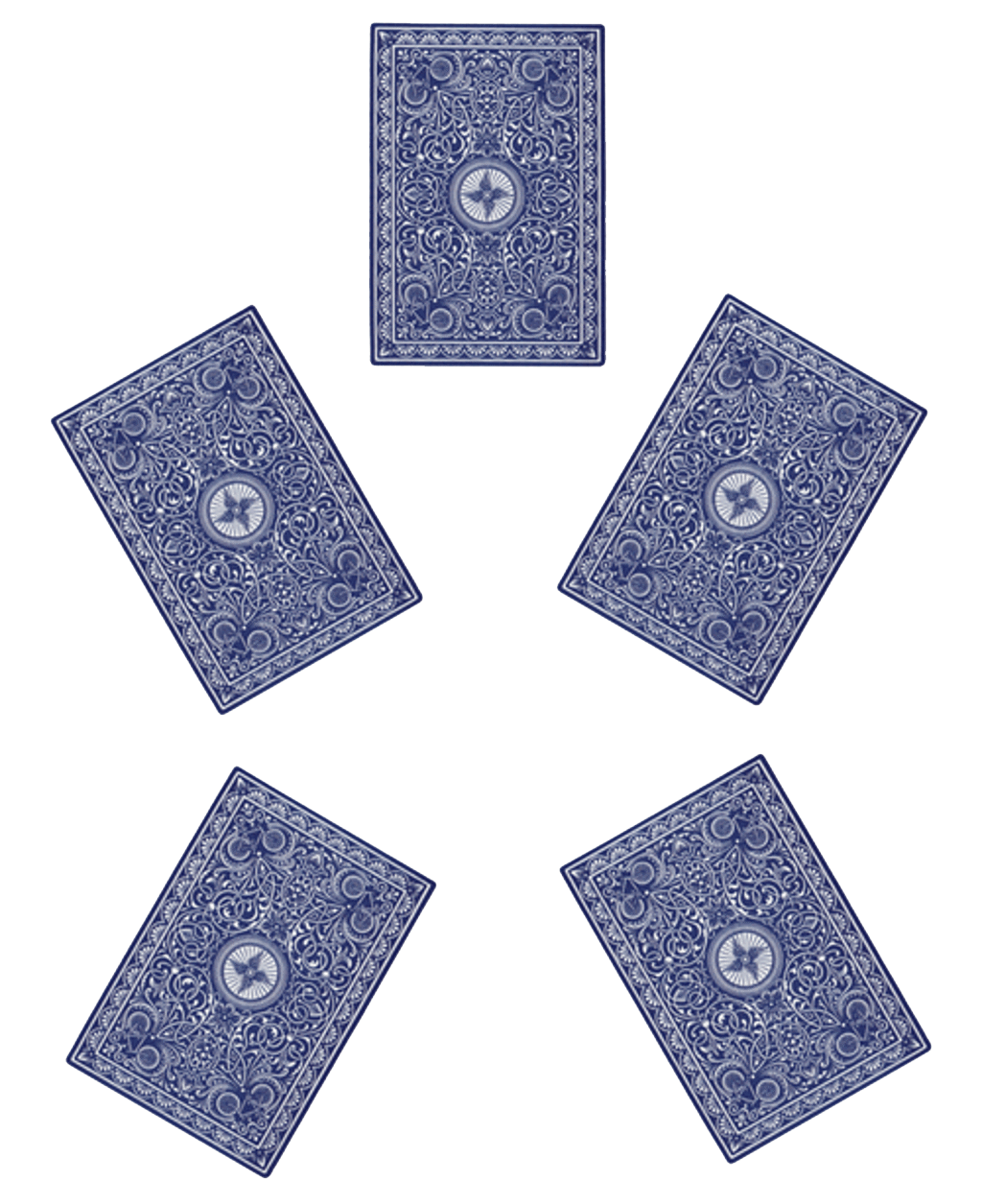 One more prank? In the ChessBase office one day I took Nihal aside and said to him: "Listen, the cards will be laid out like a human body. You must signal me the card they touch." Just that. He had absolutely no idea what I was talking about.
A short while later I laid out five cards in this pattern and asked members of the staff to touch one of them, while I had my eyes closed. When I opened my eyes there was no signal from Nihal, who stood next to me. So I simply guessed. Wrong. They had touched the card in the middle on the left. "You should have moved your left arm," I said to the onlookers in general. They did not know what I meant – but Nihal did!
We tried again, and this time I saw from the corner of my eye that he was vigorously moving his right leg. I pointed to the corresponding card, and everyone said "Yes, you got it!" That's where the fun began.
I performed the trick again and again, always telling them which card they had touched. I inevitably got it right, and the astonishment grew. Nihal kept getting better, moving the arm, leg or head to signal me, and doing it subtily. In fact he started to lead the investigation, insisting I cover my head with an overcoat, or leave the room altogether. He instructed everyone to not look at the cards when I returned. And still I got it right. "How can he be doing this??" Nihal screamed in anguish, just seconds after he had signalled me which card it was.
This was world-class pranking. He even discussed with the staff, and his second Srinath, whether I might have some form of paranormal facility. Maybe I could really read minds, he speculated. In the end, when everyone gave up, I revealed the ruse. Nobody could believe that the 12-year-old had so flawlessly pulled this off.
In the meantime, while I write these lines, Nihal has turned eighteen and has reached a rating of 2673. His meteoric rise has flattened out somewhat, but he still dedicates all his waking hours to the game he loves. I believe he is still on a path to the very top.