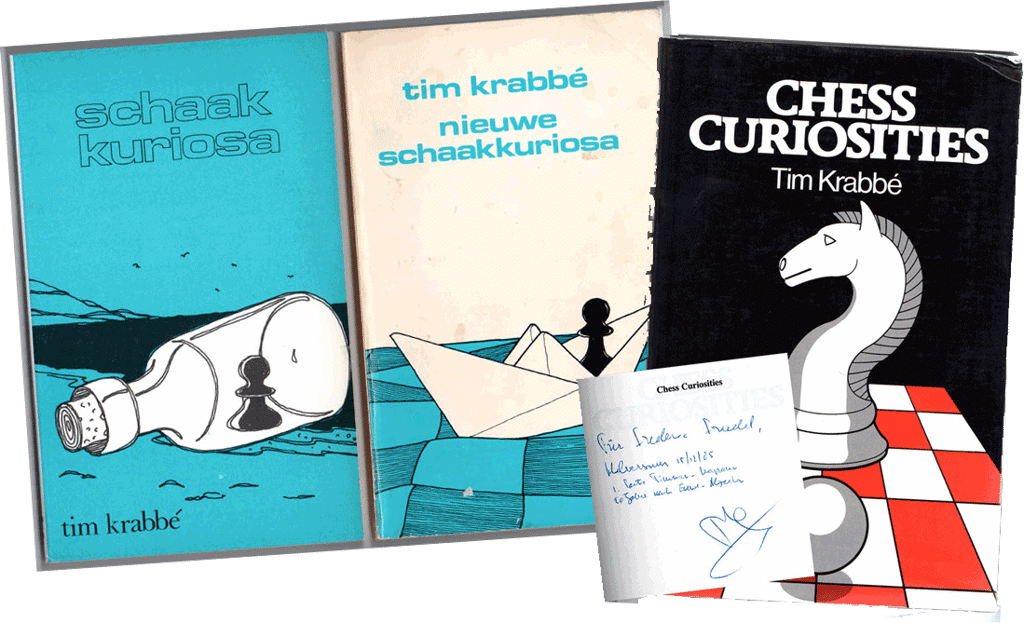
I was always a great fan of Tim Krabbé, Dutch journalist and novelist. I bought his books, schaakkuriosa and Nieuwe schaakkuriosa and in fact learnt to read Dutch chess texts to understand them. Then, in December 1985, Tim gave me a copy of the English translation. I think I must have read it cover to cover, some stories more than once. One really moved me, and in 1986 I wrote my first article on the subject, followed by a number of follow-up stories over the decades. Here I am going to retell the poignant tale that fascinated me over the years. Warning: you must have robust nerves to read it.
Allumwandung" – that is the German word for a pawn converting to all four pieces in the course of the solution to a chess problem or study. Many problemists attempted to compose positions with allumwandlung. The first (I believe) to find a position that fulfilled the theme was the Norwegian Niels Hoeg, who took twelve years to compose it.
The solution starts with 1.f7! I want you to switch on the engine (fan button under the diagram) and enter this move on the board. Now you can try black defences: 1...e4, 1...exf4, 1...Kf6 and 1...exd4. In each case the engine will continue with 2.f8Q, R, B and N. The engine will immediately show you why other promotions for White will fail. A wonderfully clean allumwandlung which you are bound to enjoy.
Babson
Some years later, in 1925, an American composer, Joseph Ney Babson, was experimenting with the allumwandlung, and especially with the following daring extension. He imagined a direct mate problem in which:
- White makes the first (key) move
- Black defends by promoting a pawn to a queen, rook, bishop or knight
- As a replay White is forced to reciprocally promote to queen, rook, bishop or knight
Babson died in 1929 with no solution in sight. Five years later the great endgame expert André Chéron, who had composed positions with eightfold rook underpromotions, wrote: "a direct mate Babson problem will never be composed."
 Drumare
Such challenges are very difficult to resist, at least for some people. In 1965 the French engineer Pierre Drumare, born in 1913, published an article entitled "Searching for the impossible", describing how he had spent on average four hours a day for a whole year working on the Babson problem. The best he could come up with was a position in which Black has just moved his pawn from f2 to f1. If he takes a queen, rook, bishop or knight for it, White must take the same piece when capturing a rook on g8, to mate two moves later. Drumare admitted that it was "just a small step on the road to the impossible," but it helped him understand just how difficult the task was. He was especially frustrated by the knight and its limited range. That made forcing an underpromotion to a knight after Black had underpromoted to the same piece on the other side of the board unattainable.
But Drumare continued working. Fifteen years later he at last presented his Babson.
"Words (and chess sets) fail here," wrote Tim Krabbé in Chess Curiosities. The position is completely illegal, and during the solution (which I shall not give here) nine rooks and nine bishops appear simultaneously on the board. People called it monstrous, but Drumare explained that it was not his fault, but that of the accursed knight. The composition vividly demonstrates the deep despair of an infinitely obsessed personality.
Two years later Babson finally gave up. "After 22 years of exhausting labour I now have the certainty that the quadruple echo promotion will never be perfectly realised in a direct mate problem."
That was 1982.
Continue reading at your own risk...
Yarosh
In March 1983 a problem appeared, as number 23 in the "Originals" section of the magazine Shakhmatny. It was by a 26-year-old soccer and chess trainer from Kazan named Leonid Vladimirovich Yarosh, who had previously published only three problems in Shakhmatny and in Thèmes-64.
The Cyrillic caption to this problem said: "!!!Estj task Babsona?" and the editor asked the readers to decide whether "everything in this extraordinarily difficult construction is really correct."
If you switch on the engine in the diagram it will shows you that it is: if Black defends by capturing on b1 and promoting to a queen, White must capture on b8 and also promote to a queen in order to mate in four. If Black promotes to a rook White must counter-promote to a rook, if Black takes a bishop White must do likewise, and if Black promotes to a knight White must take a knight too. The full solution goes as follows
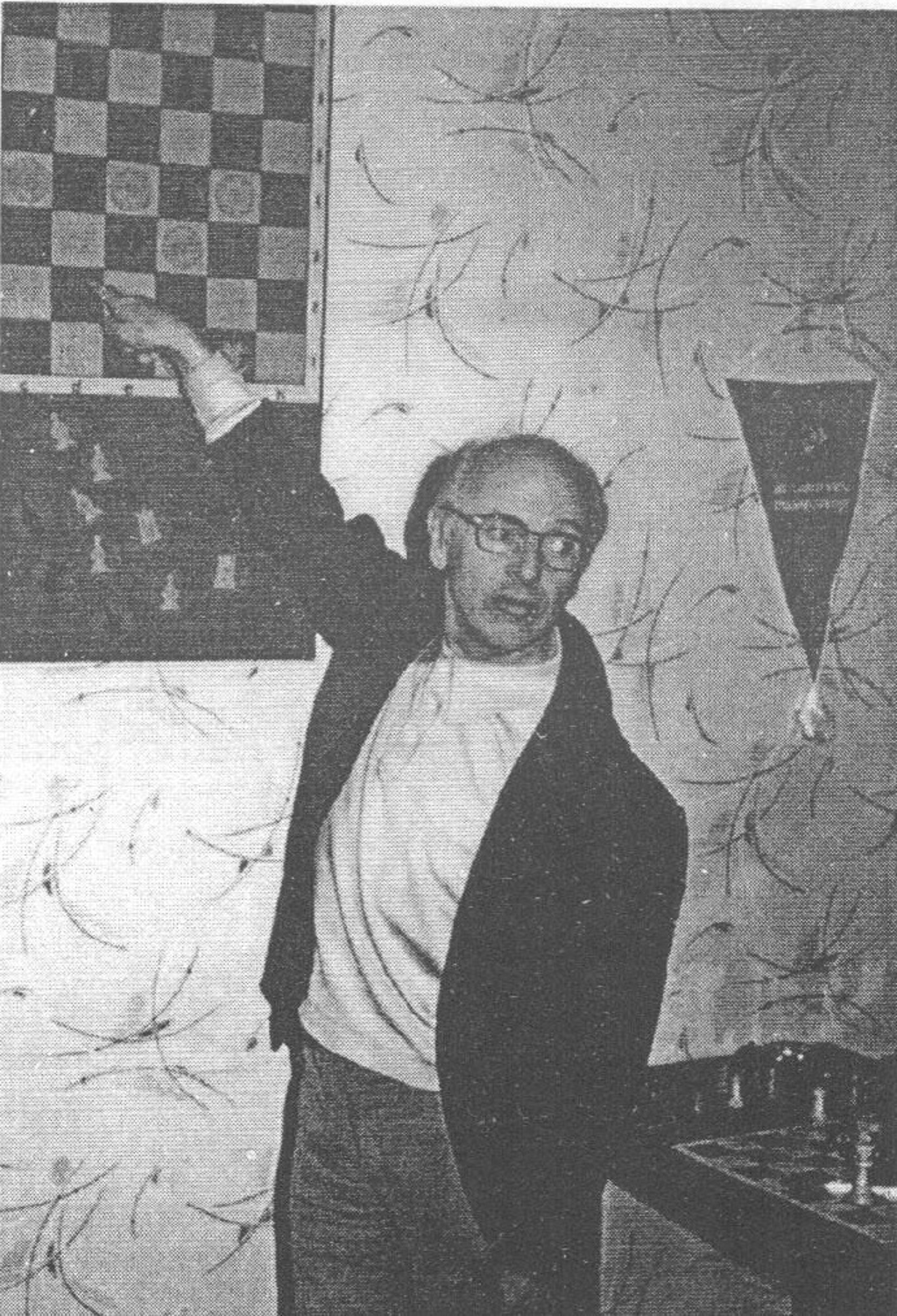
"There it was: the Babson task," wrote Tim Krabbé. "Tantalisingly simple, and of an elegance no one in his right mind could have dreamt of." 19 years later, in 2002, Tim Krabbé undertook an adventerous trip to Kazan to meet the unknown composer, who he has made sure would be remembered as long as there is chess. The pictures of Yarosh were made by Rick Goetzee, "my companion on my trip to God," (Krabbé) and originally appeared in the Dutch newspaper Algemeen Dagblad.
It is difficult to imagine what Drumare must have felt when he saw Yarosh's problem. "I have erred, but I am happy for the art of the chess problem," he wrote in Thèmes-64, and in a personal letter to Yarosh: "Your problem will be admired in the future, like we admire the masterpieces of our ancestors in the museums and cathedrals."
The amazing Yarosh did not leave it at that. The ugly capture key had preyed on his mind and a few months later he presented another perfect Babson, again in the form of a light, elegant position with a perfect key move. He received a first prize for this.
In this second version of the problem there is a tiny little flaw: in the last move of the line with the bishop underpromotions White can mate with either 4.Be3 or 4.Be5. So Yarosh, for whom our repertoire of adjectives now fails, went to work and in the same year produced a third, completely different version without the mating dual.
In this most perfect version the incredible Yarosh has even got rid of the mating dual in the bishop line. He dedicated this problem to P. Drumare. And others took up the task as well. To date over twenty Babsons have been devised, Our hearts bleed for Pierre Drumare.