All chess engines do not actually calculate in the opening phase of a game; instead they retrieve their moves from a pre-stored file, the so-called openings library. With the help of the openings book, the chess engine ideally plays moves that have proven themselves in tournament practice. The advantages are clear: the computer saves a considerable amount of thinking time, since it does not have to calculate the moves, and at the same time it avoids gross strategic errors in the opening.
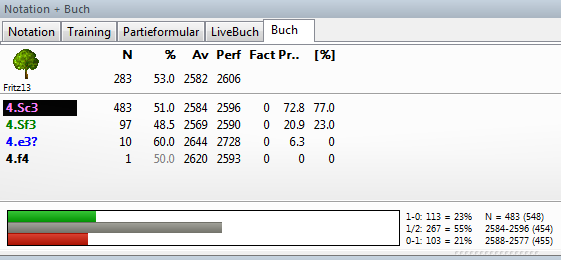
In our chess engines the library is provided in the form of a position tree, in which all stored moves are linked together. The particularity of the position tree is above all that a wealth of important information is stored with each move. With this concept, for example, it is no problem at all to find out how often a particular move has been played, what success rate the player who plays it can expect, or in which period a particular continuation has been used particularly often. Essentially, a well-maintained position tree functions not only as a library but at the same time as a database for assessing and evaluating all kinds of questions that can arise in connection with opening theory. The advantages of this concept are significant:
• The user can quickly and specifically prepare for a particular opening variation and examine all moves played in this variation so far for their suitability. He can also recognise "at a glance" where the known theory ends, without having to leaf through various chess books or electronic game databases. Since the position tree is simultaneously used by the chess engine as an openings book, the newly acquired knowledge can be tried out and trained directly against the computer.
• The chess engines use the information from the position tree creatively. If, for example, in a given position there are two moves to choose from, of which one has been played three times and the game was lost three times, while the other has a 60% success rate over 100 games, the program will interpret this information accordingly and play the more promising move. A further advantage of the concept is that the user can better influence and control the program's choice of moves in the opening. Through a multitude of settings, you can almost continuously determine whether the program should play only the best moves or should choose more varied, potentially worse moves. You can also restrict the preferences to the main variations or the sub-variations.
• Another advantage of the position tree concept is that the tree can easily be supplemented and updated by importing current games. This ensures that the library always remains up to date in terms of opening theory.
See also LiveBook ....